
Reflections
REFLECTIONS ON THE WRITING PROPHETS
‘Reflections’ on the Writing Prophets 31
E Z E K I E L
A “minor” prophet Ezekiel is not. God entrusted this man with prophetic messages of great significance. Some we are privileged to see unfolding before our own eyes this very day. Much of it (chapters 40 - 48) is still future to us. Both Ezekiel and Daniel are included in this series of ‘reflections’ even though they properly fit in with Isaiah and Jeremiah, and called “major” prophets. That terminology has nothing to do with the prophetic importance of their message, but relates to the length (number of words) of their contribution.
Ezekiel was a priest. A contemporary of both Jeremiah, also a priest who was about 20 years older, and Daniel, who was about the same age as Ezekiel. He is precise in his dating of his call to prophecy. He was among 10,000 who were taken captive to Babylon in 597 BCE (2 Kings 24). He then resided at Tel Abib, by the River Chebar, in his captivity. It was there that he had “visions of God” and the “word of the LORD came expressly to him”. Now what he saw is not easy to interpret. It has similarities to the scenes shown to John in Revelation. The description of the “four living creatures” is detailed, unlike anything seen by man on this earth. Able to move in any direction. The “wheels” are descriptive of a kind of chariot which moved effortlessly along with these “creatures”. It is emblematic of God’s omnipresence in judgement, here there and everywhere. Inescapable. In appearance like a man. But God is Spirit. We may conclude that this speaks of the One we identify as God the Son. Ezekiel was overwhelmed and fell on his face. “This was the appearance of the likeness of the glory of the LORD” he said. Then he heard the voice.
“I am sending you to the children of Israel, to a rebellious nation that has rebelled against Me; they and their fathers have transgressed against Me to this very day”. In preparation for his task, Ezekiel was given the vision of a “scroll of a book written on both sides”. A scroll is normally only written on one side. The vision is that the message was doubly full of “the lamentations and mourning and woe” that God wished to convey to the Israelites. But first Ezekiel was to “eat the book”. It is a good lesson. Before one can teach the word of God, one has to internalise its content. Be familiar with the promises, the judgements, commandments, statutes, precepts, and expectations written in that word. As God continued to give Ezekiel details of his assignment, it seems as though he was on mission impossible. “But the house of Israel will not listen to you, because they will not listen to Me; for all the house of Israel are impudent and hardhearted”. But what I see is that God was intent on giving everyone the opportunity to get right with Himself. Every nation is made up of individual citizens. And whilst it is true that God deals with nations, He also deals with individuals. Ezekiel’s mission was not futile. God does not deal in futility.
In his many conversations with the LORD, Ezekiel is invariably referred to as “son of man”. It has no relevance to the message. “I have made you a watchman for the house of Israel”. That has great relevance. We are all “sons of men”. It is the message which has relevance. It did for Ezekiel, it does for us all. “Therefore hear a word from My mouth, and give them warning from Me”. This, my dear friends, is a universal message from the LORD. Ezekiel, (and by extension each of us), is charged with the role of messenger of the LORD. “When I say to the wicked, ‘you shall surely die’, and you give him no warning, nor speak to warn the wicked from his wicked way, to save his life, that same wicked man shall die in his iniquity; but his blood I shall require at you hand. Yet if you warn the wicked, and he does not turn from his wicked way, he shall die in his iniquity; but you have delivered your soul.” The message of God is abundantly clear. His concern for Israel is a concern for each individual within that nation. Ezekiel’s charge, to “eat the book”, to go to the people, to provide warning out of his intimate knowledge of God and His word, is to ensure that no-one will be able to say “I didn’t know”. And IF such a person is able to say “I had a friend who was a believer but he never warned me”, God says the blood of that person will be required of the one who did not provide the warning. As I ‘reflect’ on this Scripture, the main message for me is my appointment as a “watchman for the LORD”.
Ezekiel, in his vision saw other unusual instructions. Confinement in his own house, bound with ropes, unable to speak. “But when I speak with you, I will open your mouth and you shall say to them ‘Thus says the LORD’.” It appears to me like the old adage of parents to children “speak when you are spoken to”. Regardless of his knowledge and understanding of God, Ezekiel is told to speak only when God directs him. Today we might say that we need to be sensitive to the Holy Spirit in our utterances. As God directs. It’s like an arrow, not a scattergun.
The LORD wanted Ezekiel to feel the intensity of the sin of Israel and for Judah. The manner in which this was conveyed was by him making a clay portrait of the city. To metaphorically lay siege to the city. For Israel to feel the pain of lying on his side, without moving, for 390 days. Then for Judah, to lie on his other side for a further 40 days. His food was to be cooked over a fire made of human waste. Utterly defiled. It was a picture of what would happen to the Israelites in their exile from the land. Obliged to eat what the gentiles ate. Cut off from that which they were used to in the land of God’s promise. Free to live as God intended. Undefiled by pagan influence. They were to pay an enormous price for their disobedience to the covenant they had sworn to keep. The message of Ezekiel was for them. The application is for us.
Shabbat Shalom
RS
TORAH REFLECTIONS PESACH
Torah Reflections “Pesach 2”
Torah portion Exodus 13 : 17 - 15 : 26
Haftarah portion Numbers 28 : 16 – 25
The Torah of YHWH given to Moses
We come to the last day of the celebration and remembrance of “Pesach”.
The parashah narrative begins with the statement of fact that the Pharoah had finally agreed to “let the people go”. It continues with the story of the journey of escape from Egypt, and the drowning of the pursuing Egyptian army, and it ends with the provision of “sweet water” to drink out of the bitter waters of Marah. A fascinating story.
These events are well known. Even non-Christian sceptics are familiar with the story, so we do not need to re-visit the detail. But we need to find the lessons for ourselves as the story unfolds.
Last week we focussed on the prophetic significance of the whole season of the three Pesach festivals. This week we learn of the detail of the way the event unfolded for them in practical terms. In fact, as we arrive at the very end of the “Feast of Unleavened Bread” in our study this week, we see the hand of Almighty God, and a picture of Yeshua Ha’Mashiach in this parashah.
We could look at the provision of food, which rained down from Heaven each night, sufficient to satisfy each family for the whole day ahead. And that which was not eaten that day rotted before the next day! It was to be gathered and eaten FRESH each day (Miraculously, the same food lasted TWO days when the weekly Shabbat came around).
The Apostle John, in Chapter 6 from verse 32, records the words of Yeshua when He described Himself as “the Bread of Life”. He goes further by relating the “bread from Heaven” in Moses time with Himself.
“Then Jesus said to them, "Most assuredly, I say to you, Moses did not give you the bread from heaven, but My Father gives you the true bread from heaven. For the bread of God is He who comes down from heaven and gives life to the world."
It is not going too far to equate the Israelites need for a daily gathering of that bread, with our need today for a ‘daily gathering’ of the bread which Yeshua is. He taught us to pray ‘give us this day our daily bread’. I believe that this phrase has both a literal and a spiritual meaning. We need to gather our ‘bread’ DAILY, just as those Israelites did in our parashah.
We could look at the provision of water. Moses was told to strike the rock, out of which poured an abundance of clean fresh, life-giving water. Our beloved Apostle Paul, writing to the church at Corinth used a most interesting description of this water.
“Moreover, brethren, I do not want you to be unaware that all our fathers were under the cloud, all passed through the sea, all were baptized into Moses in the cloud and in the sea, all ate the same spiritual food, and all drank the same spiritual drink. For they drank of that spiritual Rock that followed them, and that Rock was Christ” 1 Corinthians 10 : 1- 4.
Paul is suggesting here that the miracle of the provision of water from the Rock extended to that Rock actually following them around!! The plain sense of this is that it was Yeshua Himself, there with the Israelites on their journeying’s in the wilderness who sustained them with life giving water. On another occasion, when Yeshua was attending the Feast of Tabernacles in Jerusalem, at the time of the water libation Ceremony in the Temple He said:-
“On the last day, that great day of the feast, Jesus stood and cried out, saying, "If anyone thirsts, let him come to Me and drink. He who believes in Me, as the Scripture has said, out of his heart will flow rivers of living water."” John 7 : 37,38
So then, as the “mo’ed” of Pesach concludes for another year, we remind ourselves that the Passover Seder which starts the celebration of this season always ends with the participants saying “Next Year in Jerusalem”. An anticipatory statement about the coming of Messiah.
So we who are believers in Yeshua, can see the way in which this “appointed time” of Pesach not only speaks of Yeshua perfectly fulfilling His role as the ‘Lamb that was slain’, but also throughout the whole parashah we have reminders of His role in our lives as the sustainer of our life.
For the believer, without Him there is no hope of life. With Him we have abundant life …. IF we choose to access it. Praise be to Him.
Shabbat Shalom
RS
REFLECTIONS ON THE WRITING PROPHETS
‘Reflections’ on the Writing Prophets 30
D A N I E L
The revelation given to Daniel, of times still future to us, is quite amazing. Could there be anything more to tell? Daniel was so disturbed by what had been revealed that he had “mourned” for three weeks and hadn’t eaten all that well either. A few days later he was with friends, on the banks of the River Tigris, when he had another visionary experience. It seems that when Gabriel explained the events leading to what we know as “Daniel’s 70th week”, he hadn’t explained events closer in time. So he returned to fill in those details. Daniel’s friends, although not seeing Gabriel, were filled with terror, and fled! Daniel collapsed, but clearly heard the words spoken by Gabriel. “O Daniel, man greatly beloved, understand the words that I speak to you, and stand upright, for I have now been sent to you … for from the first day that you set your heart to understand, and to humble yourself before your God, your words were heard, and I have come because of your words”. He then went on to explain that for three weeks (coinciding with Daniel’s ‘mourning’) there had been a “battle in the heavenlies” with satan’s emissary, called ‘the prince of the kingdom of Persia’ (see Revelation 16:14). We are given a small glimpse here of the battles which take place in the heavenlies, because Gabriel was left alone, but received help from Michael (Revelation 12:7). It seems fair to conclude from this that both satan and Almighty God, have angels responsible for the affairs of nations of the earth doesn’t it? That shows how important then it is for us to pray for our nation.
Now back to the vision of Daniel. What follows is a pre-event view of the future kingdoms which accord with the visionary statue of Nebuchadnezzar. The Medo-Persian empire, led by the powerful king Cyrus. Four kings who are prophesied to succeed Cyrus (now according to known history) brings us to Xerxes (In the book of Esther he is known as Ahaseurus). He had a disastrous military campaign against Greece in about 480BCE, and this began the substantial weakening of the Persian empire which eventually fell to Greece in 330BCE under the command of Alexander then Great. A good ancient history book can fill in the minutia.
In the complicated account related in Daniel 11:5-20, a period which covers about 200 years is prophesied. It relates to wars, disputes, alliances and changes which occur to bring about the replacement of the Greek empire with that of Rome. The ‘vile person’ referred to in verse 21 is none other than the Syrian persecutor of Israel called Antiochus IV Epiphanes. It was a period of great distress and bloodshed. A period prophesied in Scripture, but with no Biblical canon recording those events. Secular history does. It was a time when there does not appear to have been much ‘honour’ displayed. It was a time of ‘survival of the fittest’, or more appropriately perhaps, the one with the strongest army or the most devious methodology. The ‘defilement’ of the temple (v 31) is prophesied. It was actually a time of great stress for Israel. There was much division, largely between “Hellenised Jews” and “Pharasaic Jews” which is again prophesied (v 32). “Those who do wickedly against the covenant he shall corrupt with flattery; but the people who know their God shall be strong, and carry out great exploits”. The Jewish historian Flavius Josephus, in his book “Antiquities of the Jews”, credits the person called Judas Maccabeus with the overthrow of those who defiled the temple, around 165 BCE. The temple was re-dedicated and that event is now celebrated universally by Jews in the joyful annual festival called Hanukkah (Festival of Lights).
(In the interests of literary honesty, it is noted that Jewish scholars, using Jewish calendar historical dates to interpret Daniel 9 specifically, identify the destruction of the temple in 69 CE as the end of “Daniel’s 70th week”. The horrors of the FOURTH beast seem to be discounted to a degree. And life goes on as normal after that.)
As this prophetic book comes to a close, Gabriel returns to the matter of that “70th week”. Michael again has a role. On this occasion (of gentile invasion) to help, watch over, and support Israel. “And at that time your (Daniel’s) people shall, be delivered”. Or as Paul puts it “All Israel shall be saved” (Romans 11:26). It foresees a time of resurrection “Some to everlasting life, some to shame and everlasting contempt”. It is a description of Daniel 9 and Revelation 20. In my writing of these ‘reflections’ over a number of years, I have come to appreciate that it is often difficult to separate ‘the God view’ of time, from man’s view of time. In that inability, we can be easily be confused by events which we might see as sequential, but which may overlap or be separated by many years. I came to that appreciation especially in attempting to unravel the events of Revelation. So it is with Daniel too. “But you Daniel, shut up the words, and seal the book until the time of the end; many shall run to and fro, and knowledge shall increase”. I think that is an invitation to watch, to pray, to study, to seek wisdom, so that our understanding is enhanced. But our understanding, or lack of it, has no impact on God’s plan.
Daniel asked how long shall the fulfilment of these wonders be. He was shown “the man clothed in linen who held up his hands to heaven, who swore by Him who lives forever, and said ‘for time, and times, and half a time”. 3 1/2 years. Then what will happen? asked Daniel. “Many shall be purified, made white, and refined, but the wicked shall do wickedly; and none of the wicked shall understand, but the wise shall understand”.
“Blessed is he who waits, and comes to the 1335 days”. That is just 45 days after the end. The time for transition, from this age to the next!!
May God grant us wisdom to understand, and be saved.
Shabbat Shalom
RS
TORAH REFLECTIONS PESACH
Torah Reflections “Pesach 1”
Torah portion Exodus 12 : 21 - 51 Numbers 28 : 16-25
Haftarah portion Joshua 5 : 2 to 6 : 1
The Torah of YHWH given to Moses
The regular sequence of Torah readings is interrupted this week because of the “mo’ed” of Pesach.
Leviticus 23 and Deuteronomy 16 have the commandments about annual observances of the “mo’edim”. (The Hebrew word for “appointed times”, which in turn is usually translated into English as “feasts”). These are times when God specified He would meet with His chosen ones.
Today, they are most often referred to as “Jewish Feasts”. That correctly describes the fact that they are observances remembered by Jews. But it is an incorrect understanding of the Scriptures.
When God gave these instructions to Moses, He carefully worded these ‘appointed times’ (mo’edim) as MY ‘mo’edim’. They may be characterized as times when God says, in effect, “I will be there to meet with you on these specific occasions”. Those who choose not to attend miss an opportunity of blessing through meeting with Him at His invitation.
This festival, known as “Pesach” (Passover), embraces THREE festivals in a period of eight days. The first of these remembers the actual day in history (the 14th day of the first month, Nisan) when the Israelites experienced the ‘salvation’ of the firstborn in their families by placing the blood of the Pesach Lamb on the doorposts and lintels of their houses in Egypt. The Lord ‘passed over’ their houses when He saw the blood.
It also is the exact Hebrew calendar date of the crucifixion of Yeshua. The Christian celebration of Easter (replacing Passover) was formalized at the Council of Nicea in the days of the Emperor Constantine of Rome. It signalled the official separation of the “church” from its Hebrew roots. (In my view one of Satan’s major victories over mankind).
The second remembrance is known as the “Feast of Unleavened Bread” which occurs on the very next day, Nisan 15. (It is a High Sabbath), and it lasts seven days, and begins and ends with a special Sabbath, Note that there are always three Sabbaths during this Pesach festival. The “High Sabbath” which marks the beginning of the Feast of Unleavened Bread, (and the Sabbath which marks the end of the festival, PLUS the normal weekly Sabbath). It is this “High Sabbath” which is the Sabbath mentioned in John 19:31 before which the Jews were anxious to confine Yeshua’s body to the grave. Then the ‘normal’ weekly Sabbath occurred immediately prior to the resurrection of Yeshua. This confirms the statement of Yeshua in Luke 11:29 (as well as in Matthew and Mark) when asked for a sign. Read it. The complete lack of understanding of this fact has caused conventional church teaching to major on an incorrect “Good Friday” crucifixion story !
Unleavened Bread is eaten during the whole eight day period of the Pesach remembrance. To Jews it is a remembrance of the fact that they ate unleavened bread,(as commanded in Exodus 12:18) as they fled from Egypt on the night of Passover. Leaven is a symbol of SIN, so to believers, the Unleavened Bread also represents the sinless body of the Messiah which was buried in the grave for three days and three nights.
The third festival in this Pesach season is the “Feast of Firstfruits”. It occurs on the day AFTER the weekly Sabbath in Pesach week. (Always a SUNDAY). It signified the beginning of the Barley Harvest and was celebrated by a priest waving an ‘omer’ (a measure) of Barley in the temple in Yeshua’s day. But it was also the day on which Yeshua was resurrected from the grave. Believers refer to it as Resurrection Sunday. (but in association with Easter rather than Passover!) It signifies that Yeshua became the “Firstfruits from the dead”. (see 1 Corinthians15:23).
We should be grateful that churches worldwide (all varieties) remember the death and resurrection of Yeshua. And that they do so sincerely. But more and more, many people are realizing that our roots are inextricably founded in Judaism and the Lord’s “mo’edim” (appointed times). Those that do then focus more on Passover than Easter.
In addition to your own church fellowship, this year, take the trouble to find a fellowship of believers who celebrate Passover and join them in that celebration. You will be enlightened, blessed and immeasurably enriched as you do.
Chag Sameach (Happy Holiday)
Shabbat Shalom
RS
REFLECTIONS ON THE WRITING PROPHETS
‘Reflections’ on the Writing Prophets 29
D A N I E L
Daniel was a Bible student! He had read that the Babylonian captivity (as it became known) would last for 70 years (Jeremiah 25: 11.12). After which, the Babylonians would themselves feel the heat of God’s wrath. It seems that the faithful Daniel was keeping track of the years. Darius, the Mede, was ‘made king’, presumably by Cyrus, when the Babylonians were overthrown by the Persian Empire. Daniel judged that the “captivity” of the Judeans, was about to come to an end. So what did he do? “Then I set my face toward the LORD God to make request by prayer and supplications, with fasting, sackcloth and ashes.” “Fasting” is familiar to us, even today, but “sackcloth and ashes” is not. It is a sign, to others, of deep mourning, sorrow, and even repentance. That is what Daniel felt as he approached the LORD. He was acutely aware of the righteous judgment of the LORD in expelling the people of Judah from the land. He took nothing for granted. He did not think “ho-hum”, we’ve done the time, now let’s get back to normal. Daniel had acquired a deep sense of awesome reverence towards His God. If we learn nothing else from this prophetic book, we will have done well to learn that. And practise it.
The prayer of Daniel recorded here is worth reading … many times. It begins with ‘confession’ of known sin. It does not appear to be his ‘personal sin’ but ‘national sin’ that is confessed. There is enough in the text that has gone before to suggest that Daniel himself was pious in his own observances and attitudes towards God. He was not a self righteous man. Another lesson. “O LORD, great and awesome God, who keeps His covenant and mercy with those whom love Him, and with those who keep His commandments, we have sinned and committed iniquity, we have done wickedly and rebelled, even by departing from Your precepts and Your judgements.” It is unusual to hear such prayer today. Most of us have little or no concept of obedience to the precepts and judgments of God. It is somehow taken for granted that “going to church” is suffice. It is man that looks at appearance. God sees the heart. As Daniel continued, he considered their neglect of the warnings of the prophets who spoke in the name of the LORD. He saw that it was to their shame that God, in righteousness, had driven them out of the land, because of their unfaithfulness. They had not walked in conformity and obedience to the Torah of God, given to Moses. The curses contained within that Torah had been justly visited on the people as a result. But Daniel also knew the heart of God. “O LORD hear! O LORD forgive! O LORD listen and act! Do not delay for Your own sake, my God, for Your city and Your people are called by Your name”. A heartfelt plea for compassion.
The response from God did not take long. At the time of the evening offering (of prayer and thanksgiving) that same day, the man Daniel identified as Gabriel, who was sent by God Himself arrived again. “O Daniel, I have now come forth to to give you skill to understand. At the beginning of your supplications the command went out, and I have come to tell you, for you are greatly beloved; therefore consider the matter, and understand the vision”. That vision is the one recorded for us and which begins in Daniel 7:13.
I am very conscious that a number of learned people have written books about this. It has caused division in some circles, and profound joy in others. I have no wish to participate in controversy, but I share what God has shown me as I ‘reflect’ on these matters. It is also difficult to not be influenced by the various interpretations which have been offered by others.
There is general agreement that the word “weeks” is not literal to our understanding of a week of seven days. It is derived from the Hebrew word “shab’ua” which has a meaning of “sevens”. But the word “seventy” is literal. So it has been regarded that the text refers to “seventy sevens”. The text also clearly refers to the appearance of Messiah Yeshua on earth. This is mentioned by Gabriel in his explanation to Daniel. We KNOW exactly when that occurred in relation to the time of Daniel’s life, so it is a small jump, with a bit of arithmetic, to deduce that the “seventy sevens” refers to “sevens of years”, which is 490 years. The commencing point is “from the going forth of the command to restore and build Jerusalem”. Then, until Messiah comes, “there shall be seven weeks and sixty two weeks”. So that means 49 years, plus 434 years. A total of 483 years from the command to restore Jerusalem until the “Messiah is cut off (from the earth “but not for Himself”)”. Please excuse the fact that I am not going into dates here for convenience sake (my own!). Those calculations have been verified many times. In very broad terms there is universal agreement of dates. Starting when Nehemiah received Artaxerxes authority to rebuild the city of Jerusalem, to the crucifixion of Yeshau. 483 years exactly. So we are left with another seven years. Those seven years are always referred to as “Daniel’s 70th week”.
Now there is another ‘prince’ mentioned. One who will destroy the city again. “He shall confirm a covenant for one week (Daniel’s 70th week); but in the middle of the week he shall bring an end to sacrifice and offering.” This is the prophecy about the arrival of “the man of peace”. He is the one who will demand worship of himself. He is the one who will be “different to all the beasts that went before it”. This is the FOURTH beast of Daniel’s vision (Daniel 7).
For those living at the time of his appearance, it will be the ultimate test of faith. A test that has been foreshadowed in the life of the faithful Daniel, from whom we have much to learn.
Shabbat Shalom
RS
REFLECTIONS ON THE WRITING PROPHETS
‘Reflections’ on the Writing Prophets 28
D A N I E L
Continuation of ‘reflection’ (27 A) on the FOURTH beast of Daniel’s vision.
It is appropriate to consider the interpretation of Nebuchadnezzar’s dream in conjunction with this ‘vision’ of Daniel’s which we are seeking to understand. We recall that the great statue consisted of different substances (gold, silver, bronze, iron, and a mixture of iron and clay) for parts of the body as they went from head to foot. It is generally understood that the kingdoms, which started with Babylonia at the head, were successively replaced by the empires of Medo-Persia, Greece and Rome. FOUR distinct periods of time. Four empires led by ambitious, fearsome, and often very cruel people seeking some advantage to extend their influence in the world as they saw it. The Roman Empire was, and is, quite diverse in its structure, and in one or more of its forms its global influence still exists today. Consider the far-reaching arms of the Roman Catholic Church. It still extends to the far corners of this earth. Consider also the Byzantine empire of Islam, which has flourished in conjunction with Rome, both within and beyond the boundaries of this Roman empire. The line between the Roman and Byzantine empires is somewhat blurred. It certainly IS different, and has superseded the first 3 mentioned kings above. For a time, Rome represented in the statue as IRON. But morphing into feet made of IRON and CLAY. A mixture. It is out of this final scene, the feet, that the fearsome FOURTH beast is expected to come. Is it from the Roman side? or from the Islamic side? Speculation is interesting, but futile. That is another “secret thing that belongs to the LORD”, for now.
Look again at Daniel’s description of the vision that he was shown. “Then I wished to know the truth about the fourth beast, which was different from all the others, exceedingly dreadful, with its teeth of iron and its nails of bronze, which devoured, broke into pieces, and trampled the residue with its feet; and the ten horns that were on its head, and the other horn which came up, before which three fell, namely, that horn which had eyes and a mouth which spoke pompous words, whose appearance was greater than his fellows”. To the avarice and greed of the kings that had gone before, this king added a menace which is terrifying. This beast “was making war against the saints, and prevailing against them”. It is worth noting here that many sections of the ‘church’ today preach a doctrine of “rapture of the saints”. It is not in the Bible in the form it is taught. (Read 1 Thessalonians 4:16 with Daniel 11 and Revelation 20:5) But it is a comforting doctrine, readily accepted because it conveniently declares ‘the church’ to have left this earth before this beast appears. The Scriptures noted above do not support this doctrine. A simple question comes to mind. Where do the “faithful martyrs” of the ‘tribulation’ come from? You know, the ones who reign with Messiah Yeshua in the Millenial Kingdom. It matters little what you or I think. This prophecy of Daniel is given to us, as with all the Scriptures, so that we may prepare ourselves for that which God says will happen.
Daniel had yet another vision. It seems to complement the first. But deals with the process of the overthrow of kingdoms. Babylonia was already replaced by Medo-Persia, which was the empire in which Daniel now lived. It is represented by the ram with two horns. One higher than the other. The lower horn of the Medes and the higher representing the Persians. The male goat with the “notable horn between the eyes” represents Greece, which was to supersede the Medo-Persian empire, which it did. That ‘male goat’, Greece, grew very great. Then its ‘large horn’ broke and was replaced by 4 other ‘notable ones’. Out of one of them came a ‘little horn’ of great influence. By this time, the Helenistic empire had been succeeded by the Roman empire. This “little horn” is considered to be Antiochus Epiphanes, (about 400 years later) who ruled the Syrian division with much influence over Israel. (More detail appears later when we ‘reflect’ on Daniel 11.) It was Antiochus Epiphanes who desecrated the temple. His overthrow is celebrated today in the festival known as Hannukah. He is seen as a ‘type’ of ‘anti-christ’ due to that desecration, which lasted precisely as the Scriptures prophesied, 2,300 days. Then ‘cleansed’ again for worship of Almighty God.
But there is much more to this. What happened towards the end of the Greek empire and the rise of the Roman Empire is a picture of another event which is still future to us today. As at this time, it is not possible for the temple to be desecrated because it no longer stands. It was destroyed about 70 CE, by the Roman General, Titus (later to become Emperor). So a new temple will be built. The Angel Gabriel, who appeared to Daniel as a man, was instructed to ‘Make this man understand the vision”. So Gabriel confronted Daniel whilst he was in a deep sleep with his face to the ground. Stood him upright, and said “Look, I am making known to you what shall happen in the latter time of the indignation; for at the appointed time the end shall be”. (the word ‘indignation’ (‘Heb, za’am’) is curious. It relates to a time of God’s anger at sin. Hence ‘indignation’). So, as in many cases of prophetic utterance, God has given us, through Daniel, and by definable history, a picture of the events of the future. There is much more to be revealed, and we will ‘reflect’ on those events in coming weeks.
Much of our Scripture writings deal with the prophecy of Messiah Yeshua coming to this earth, bringing salvation and hope to the faithful. Daniel was given a vision beyond that. To the final “Yom Teruah”. The sound of the trumpet which will herald His triumphant return.
Shabbat Shalom
RS
REFLECTIONS ON THE WRITING PROPHETS
‘Reflections’ on the Writing Prophets 27
D A N I E L
The prophecy which Daniel proclaimed, about 50 years earlier, when he interpreted the first dream of Nebuchadnezzar had begun to be fulfilled. Babylonia was now replaced by the Medo-Persian empire. Darius, the Mede, divided the kingdom of Babylonia, which he had conquered, into 120 regions. Daniel was made governor of one third of them. He was so successful in his management, that Darius considered putting him in charge of the whole realm! “So the governors and satraps sought to find some charge against Daniel concerning the kingdom; but they could find no fault or charge, because he was faithful; nor was there any error or fault found in him.” But that was not enough. Jealousy caused them to plot against Daniel, in order to bring him into conflict with Darius. The law of the Medes and Persians was unique in that once established, it was not possible to be changed. By anyone.
“We shall not find any charge against this Daniel unless we find it against him concerning the law of his God” they said. That is where the bait might be found. Now to set the trap. The king was persuaded to sign the irrevocable law which required that no-one be allowed to petition any god or man, except the king himself, for the following 30 days. Violation of that law was punishable by being cast into the den of lions. When Daniel was told about the decree he went to his home “and in his upper room, with his windows open toward Jerusalem, he knelt down on his knees three times that day, and prayed and gave thanks before his God as was his custom since early days”. There was no attempt on his part to hide away secretly. It was confirmation by Daniel that his trust was in Almighty God to protect him in all circumstances. Perfect trust. The conspirators soon acquainted the king with the facts, and the king then realised that he had erred in signing that decree. Try as he might, with good intent, the king was unable to circumvent the law he had signed. So it was, with a heavy heart, the king commanded that Daniel be cast, as the law required, into the den of lions. The king spoke to Daniel. “Your God, whom you serve continually, He will deliver you”. Then he retired to his palace and spent the night fasting. He did not sleep. Early the next morning the king went to the den of lions and was overjoyed to find Daniel very much alive. “O, king, live for ever! My God sent His angel and shut the lions mouths, so they have not hurt me, because I was found innocent before Him; and also O king, I have done no wrong before you” said Daniel. Then the king exacted a fearful punishment on those who conspired against Daniel. He also wrote another decree. “I make a decree that in every dominion of my kingdom men must tremble and fear before the God of Daniel. For He is the living God, and steadfast forever; His kingdom is the one which shall not be destroyed, and His dominion shall endure to the end.”
So Daniel prospered in the reign of Darius, the Mede, and Cyrus, the Persian. By now Daniel was in his early 80’s. Previously he had various “revelations” in which he was involved in interpretation of dreams. As Daniel 7 opens he described another of his encounters with the LORD. Visions in the night hours. The Great Sea stirred by the four winds. Four beasts rising up from the sea. A lion, with wings like an eagle. Lifted up to stand on two feet like a man. A ravenous bear devouring much flesh. A four headed, winged leopard. Finally a fearsome unimaginable creature with ten horns. A ‘little’ horn came and plucked three of those ten horns out by the roots. That ‘little’ horn had eyes like a man, and spoke pompous words.
Then the scene changed completely. A room, like a court room, with thrones and a Judge, the “Ancient of Days” seated. Millions of worshippers stood before the Judge. “And the books were opened”. Judgement time.
The pompous, challenging, words continued from the beast. Of no avail. The beast was slain. Its body destroyed and given to a burning flame. Finished. The other beasts had their power removed from them, but their lives were “prolonged for a season and a time”.
The scene changed again. “One like the Son of Man, coming with the clouds of heaven! He came to the “Ancient of Days” .. then to Him was given dominion and glory and a kingdom, that all peoples, nations, and languages should serve Him. His dominion is an everlasting dominion, which shall not pass away, and His kingdom the one which shall not be destroyed”.
Daniel was greatly troubled at what he envisioned. What did it all mean? So he asked one of those “who stood by” (the Throne). The four beasts are four kings which arise out of the earth. Daniel was satisfied with that. BUT what about this FOURTH beast. Ah! “The fourth beast .. shall be different from all the other kingdoms”. Powerful, destructive, speaking pompously against “The Most High”. “He shall persecute the saints of the Most High, and shall intend to change times and the law(s); Then the saints shall be given into his hands ‘for a time and times and half a time’.”
Many people have debated and ‘reflected’ on the detail of what Daniel’s vision means. Some parts are easier to understand than others. We will continue this ‘reflection’ further since there is much more to be considered. That it deals with issues still future to us is undeniable. There are very important issues to concern all who are disciples of Yeshua. The FOURTH beast is “anti Christ”. He is our enemy. Daniel has shown us his mettle in his faithfulness to his God. He was prepared to die for his faith. Many more will have to make such a choice before this “fourth beast” is dealt with.
Shabbat Shalom
RS
REFLECTIONS ON THE WRITING PROPHETS
‘Reflections’ on the Writing Prophets 26
D A N I E L
Nebuchadnezzar died about 562 BCE. Daniel was taken captive into Babylon when he was 16 years old in about 602 BCE. Belshazzar only reigned* over Babylon until about 538 BCE. So Daniel was probably in his mid 70’s when “Belshazzar the king made a great feast for a thousand of his lords .. and commanded that the gold and silver vessels which his father Nebuchadnezzar had taken from the temple in Jerusalem”. There was much merrymaking as they defiled those vessels, holy to the LORD, by drinking out of them at their feast. Try to imagine the shock and horror that struck them all as, opposite the lampstand, in full view, the finger of a mans hand appeared and wrote on the wall. The words were written in a language no-one could read. It was a conversation stopper for sure. Belshazzar shook with fear.
The ‘experts’ were called in. The magicians, the soothsayers, the astrologers, those who were deemed to have special powers. Great reward was offered to anyone who could read and interpret the words on that wall. No-one claimed the reward. Then the queen spoke to the king. “There is a man in your kingdom in whom is the Spirit of the Holy God … now let Daniel be called, and he will give you the interpretation”. What a reputation! To be known as a man in whom is the Spirit of the Holy God. What an example! What a lesson. So it was that Daniel appeared before the king and was offered the same reward that was put before the others. “Let your gifts be for yourself, and give your rewards to another”. Daniel was about the LORD’s business here. He had a message for the king and he did not need to be paid for delivering it. I find myself wondering if Daniel had read the words of Solomon (Proverbs 23:23) about not selling truth, wisdom, instruction, and understanding. The love, mercy and grace of the LORD is free. A lesson for many today who are intent on making a living out of so doing. Freely we have received, and freely we should give, as He did. But for the recipient, it comes at a cost!! Selah!
First, Daniel reminded the king about the life of his father Nebuchadnezzar. He had built a large and feared kingdom. “But when his heart was lifted up, and his spirit was hardened in pride, he was deposed from his kingly throne.” Daniel did not hold back from describing the indignity which followed that deposition. The LORD had business to conduct with Belshazzar and He had chosen Daniel to convey the details. He did not shrink from the task. “But you his son*, Belshazzar, have not humbled your heart, although you knew all this. And you have lifted yourself up against the LORD of heaven.” As I write, I can feel the horror and hurt that must have filled Daniel as he saw that the holy vessels of the temple had been so defiled. And in such a contemptuous manner. Gloating and challenging God to act against them. “Then the fingers of the hand were sent from Him, and this writing was written.” Can you visualise Daniel pointing to the wall as he spoke? (On a very personal note. It was this writing on that wall which my Saviour used to draw me to Himself. Many years ago in a small market town in Wales.)
MENE: God has numbered you kingdom, and finished it.
MENE: God has numbered you kingdom, and finished it.
The repetition of a word, in Scripture, is a sign of great emphasis. Belshazzar was being told that he had gone too far. For him it was all over. Finished. There would no longer be a kingdom for him to rule.
TEKEL: You have been weighed in the balances, and found wanting.
Did you know that God had a ‘balance’ in which people are weighed? We know about the “Books”. The ‘balances’ are something else. Most of us weigh our actions, our thoughts, our relationships in a way favourable to ourselves. God has a ‘balance’ which is accurately set, to His standards. Unwavering. Constant. True. (And as a young Billy Graham pointed out to me in that Welsh market town years ago, I was ‘found wanting’. How about you? The ‘balance’ is struck with God when we have our Saviour Yeshua step into the ‘balance’ on our side. Only then does the ‘balance’ show the correct weight.) Belshazzar was ‘found wanting’ that night.
UPHARSIN: Your kingdom has been divided, and given to the Medes and Persians.
Game, set and match against Belshazzar. “That very night Belshazzar was slain. And Darius the Mede received the kingdom”.
* (For completeness of detail here. It is claimed by some that this is inaccurate because of ‘factual’ errors regarding Belshazzar’s role. Historical records indicate that Belshazzar was the son of king Nebonidus who succeeded Nebuchdnezzar. Belshazzar was crown prince, and was given great authority by Nebonidus. An inscription found in the city of Ur in 1853 says “May it be that I, Nabonidus, king of Babylon, never fail you. And may my firstborn, Belshazzar, worship you with all his heart.” Another inscription there declares that Nebonidus entrusted the royal throne to Belshazzar.)
What is beyond all dispute is the role of Daniel, and that is the focus of this ‘reflection’. We are now finding out about a young man, just about 16 years old who displayed great faith and allegiance to the God of his fathers. God prospered him for his faithfulness, gave him great authority in a foreign land (much like He had done with Moses) and placed him in a position of some influence. As our ‘reflection’ this week ends, Daniel is a man of great wisdom, in his mid 70’s and about to enter the service of the LORD under a different ruler of another nation. God is working out His purposes.
Shabbat Shalom
RS
REFLECTIONS ON THE WRITING PROPHETS
‘Reflections’ on the Writing Prophets 25
D A N I E L
We ended our ‘reflection’ last week with Daniel recounting the dream of king Nebuchadnezzar, and providing him with the interpretation of that dream. For the sake of evidential clarity, we identified the prophetic accuracy of that dream by naming the regimes which did in fact successively replace the kingdom of the Chaldeans, right up to the present time. That’s history. It happened. It is prophecy fulfilled. But none of the regimes were named in the prophetic dream before the event. We note that there is part of that prophetic dream still unfulfilled. Many brave (or might it be foolhardy) people, have SPECULATED about the origin and identity of the final kingdom which precedes the Kingdom of Messiah Yeshua. There are no prizes for being the first to identify that kingdom. All attempts at so doing are purely SPECULATIVE. It is one of those mysteries which are “secret things” of the LORD (Deuteronomy 29:29) and speculation is unhelpful. It is a surety that when these things come about, we WILL KNOW, because God has provided us with the evidential signs of that kingdom. Specifically, a revelation of the “man of peace”. The deceiver. The Beast.
So Nebuchadnezzar made a golden statue of the image he saw in his dream. It was HUGE . Almost 30 metres high and 3 metres wide, he set it up in the plain of Dura, Babylon. All the prominent dignitaries of the kingdom turned out for its inauguration. The king was very proud of it, so much so that he demanded that at the sound of “the horn, flute, harp, lyre, and psaltery, in symphony with all kinds of music” everyone had to bow down in worship of that statue. For Daniel and his friends it was blasphemous idolatry, of which they would have no part. It did not take long before their refusal to comply with the king’s order was brought to his attention. And that spelled big trouble for Daniel and his friends. The penalty for not doing as the king commanded was to be cast into a “burning fiery furnace”. The story is well known. What remains a mystery is why Daniel was not with his friends who were cast into the furnace. We will never know. Do not speculate. What we do know is a lesson for us all. “Our God whom we serve is able to deliver us from the burning fiery furnace, and He will deliver us from your hand, O king. But if not, let it be known to you, O king, that we do not serve your gods, nor will we worship the gold image which you have set up”. Selah!
Nebuchadnezzar’s response was swift and unequivocal. Shadrah, Meshach and Abed-Nego were promoted to high office. And fierce retribution would be meted out to anyone who would speak “anything amiss” of Almighty God, who had delivered the young men from the furnace, because “there is no other God who can deliver like this”.
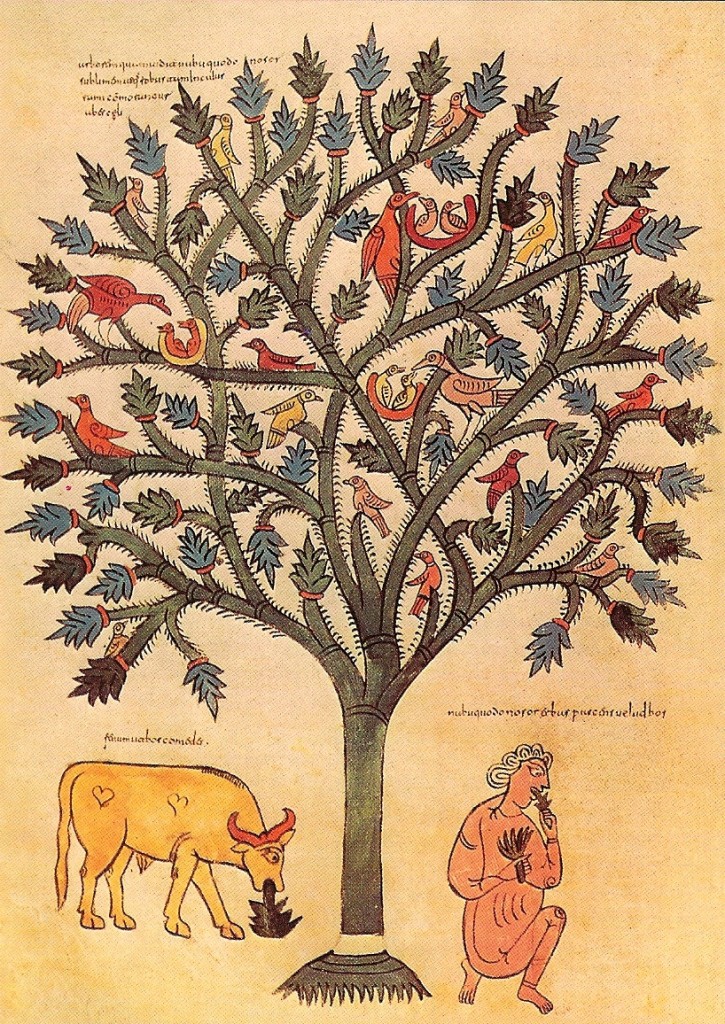
Nebuchadnezzar continued to dream! This time it was about an [Image] extremely large tree which provided food and shelter for all. But then “a holy one from heaven”, a watcher, came and gave instructions, among other things, to cut the tree down! But to leave the stump and the roots in the ground. Once again, the king invited the “wise men” to interpret the dream. And again they were unable to provide any answer. So Daniel was called to consider the matter, “for the Spirit of the holy God is in you”. As the interpretation was revealed to Daniel, he became fearful. It didn’t look too good for the king, because the tree was a representation of himself. High, lofty, proud, having the capacity to give life, and to take it away. As the king of a feared and fearsome nation, he was held in some awe. Not to be trifled with. BUT, he was being ‘watched’ .. by God, whose might and power he had seen at first hand. And what God saw, He chose to bring down, just like the tree in the dream. But still there was hope. I paraphrase part of what Daniel said. “The tree is to be cut down, but the stump and roots are left, protected by an iron band, it can be restored to you ‘but only after you come to know that heaven rules’.” Then Daniel offered some sound advice. “Break off your sins by being righteous, and your iniquities by showing mercy to the poor. Perhaps there may be a lengthening of your prosperity.”
The time scale is not specified here, so we do not know how long the events took to unfold. What we do know is that twelve months later he was still boasting about his achievements when he received another visit from the LORD. Not in a dream this time, but in a “voice from heaven”. The voice of the One who opens and no-one shuts, and shuts and no-one opens. He heard it and he understood it. “King Nebuchadnezzar, to you it is spoken: the kingdom has departed from you!” The prophetic words which Daniel spoke in the interpretation of the dream, suddenly became a reality. The king was humiliated in that he lived as an animal for an unspecified period of time. Then “at the end of the time I, Nebuchadnezzar, lifted my eyes to heaven, and my understanding returned to me; and I blessed the Most High and praised and honoured Him who lives for ever”.
It was a mighty fall from power. Not many experience such things in that same degree, but the principles remain, and the final word must go to Nebuchadnezzar. “I praise and extol and honour the King of Heaven, all of these works are truth, and His ways justice. And those who walk in pride He is able to put down.”
Shabbat Shalom
RS
Image Reference: Copyright
Illumination from Beatus of Liebana’s
Commentary on the Apocalypse (M.644, fol. 252v)
REFLECTIONS ON THE WRITING PROPHETS
‘Reflections’ on the Writing Prophets 24
D A N I E L
Not strictly a “Minor” prophet in the way such prophetic books are described. But certainly one of the truly heroic faith accounts in the Scriptures. A young man, taken into captivity, offered significant benefits to comply with the aims and objectives of his captors. Rejecting such incentives to remain faithful to the God he was brought up to believe and trust in. Prepared to die for his faith. Used by God to bring enormously important prophetic insight to the faithful down through the ages. Much of that prophecy already fulfilled, some still awaiting the LORD’s timing. Amazing. Be encouraged by Daniel’s faith.
The time of the LORD’s judgement on Judah had arrived. Nebuchadnezzar king of Babylon, with his army, was outside Jerusalem and besieging the city. It was “all over bar the shouting”. Priceless articles of worship were taken from the temple and carted off to Shinar (Babylon), and put in the treasure house of their god. Nebuchadnezzar was pretty smart. He instructed that some of the brightest children of Judah should be educated in the ways of his own people so that they could eventually serve him in his relationship with the Judeans. FOUR young men were chosen for a three year training course. They were very early deportees, being captured and taken to Babylon (very early 600’s BCE) about 20 years BEFORE the main group of exiles. One of them was Daniel. He was about sixteen years old. Very bright and a good looking lad. He was re-named “Belteshazzar”. Part of the ‘privilege’ these boys had was to eat and drink the same food as the king himself. Immediately, Daniel set himself apart by refusing to ‘defile’ himself with such a diet. Evidently non-kosher (not proper) to him. A very important distinction. I often wonder if I would have had the moral fortitude, in those circumstances, to set myself apart in that way. Would you? The word of the LORD is very clear. Read Deuteronomy 14 to check out the diet the LORD prescribed for His own. His overseer was concerned that his appearance would deteriorate if he did not eat the king’s food, and that he, the overseer, would get into trouble as a result. In the event, Daniel negotiated a test with his overseer, the chief eunuch, allowing him to eat vegetables and drink water for 10 days, after which his appearance would be judged. Surprise surprise, his complexion was improved!! Not only that, but God blessed them in their studies so that all four of these young men ‘topped the class’ at the end of their training. The word records that they were considered TEN times better than all the ‘wise men’ of the kingdom. Good start eh! “Thus Daniel continued until the first year of King Cyrus”. This means until Babylonia was itself overthrown by the Persian Empire, of which Cyrus was king at that time.
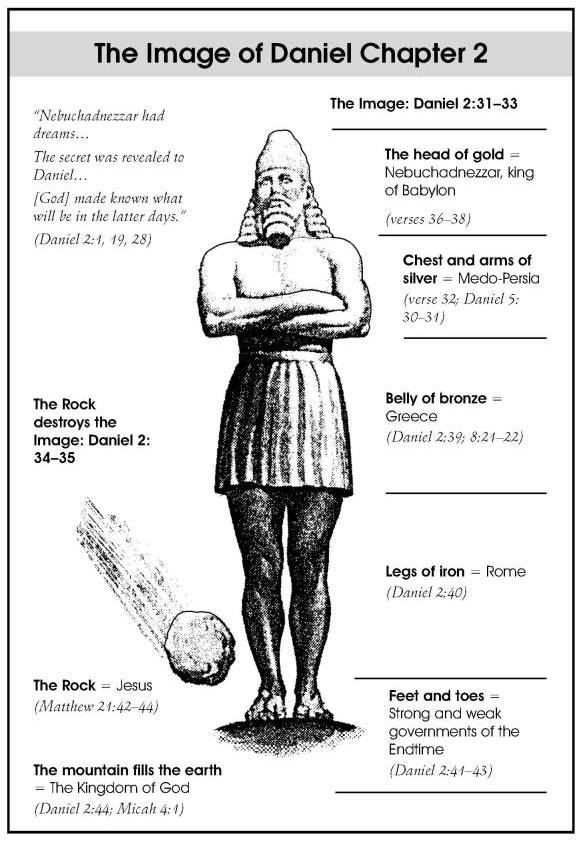 Now back to the time soon after Daniel was taken captive. Nebuchadnezzar had some troubling dreams. He became an insomniac! Couldn’t sleep. One dream was so troubling his spirit, that he couldn’t even remember what the dream was!! But he was sorely troubled by it. He wanted someone to not only [Image] tell him what the dream meant, but also what it was he actually dreamt! His magicians were put under threat of death if they could not come up with the answer. Of course, they couldn’t. So a decree was made by the king that all the “wise men” should be put to death. Daniel and his friends were also sought out as being part of that group. When the chief executioner arrived Daniel asked what was the hurry? So it was that Daniel and his friends were given time to provide the answer to the king’s request. They had a prayer meeting. God blessed Daniel, also in a dream, with both the same vision as the king and what it meant. “Blessed be the name of God for ever and ever, for wisdom and might are His”. A mighty lesson Daniel learned that night, and one which upheld him and his friends for the rest of their lives. So Daniel was taken before the king to interpret the dream that had troubled him. BUT, Daniel was careful not to “big note” himself, or to claim any credit for what he was about to reveal. Another major lesson for us all to learn. He told the king that there was no-one in all the king’s court who could fulfil the kings request, BUT, “There is a God in heaven who reveals secrets, and He has made known to King Nebuchadnezzar what will be in the latter days”. Then Daniel displayed great wisdom as he continued. “But as for me, this secret has not been revealed to me because I have more wisdom than anyone living, but for our sakes who make known the interpretation to the king, and that you may know the thoughts of your heart”. And so it was that Daniel explained to the king what that dream was.
The interpretation of that dream was another matter. Worthy of a ‘reflection’ of its own. May I encourage all who read this to make such ‘reflection’ for yourself. The dream revealed a succession of ‘kingdoms’, starting from the time that the vision was given, when Babylonia reigned supreme. Overthrown by the Medo-Persian regime (less than 100 years later). Then would come the Hellenistic period, followed by that of Rome. The Byzantine empire which lasted until a mere 100 years ago followed. That is what Daniel saw. We are now living in the part of that vision which precedes “Daniel’s 70th week”. The END Times. The time which will include the return of Messiah to reign on this earth for 1,000 years. The Millenial Kingdom of Yeshua.
All this was revealed to the youthful young man who was prepared to die for his faith. But there is a lot more to follow.
Shabbat Shalom
RS
Image Reference: Copyright © 2012 by The Family International. All Rights Reserved.