
Reflections
Tazria
Torah Portion for 3rd April - 9th April
Torah portion Leviticus 12 : 1 to 13 : 59
Haftarah portion Ezekiel 45 : 16 – 46 : 18
“Has conceived”
It’s about your body!
The parashah this week makes for quite easy reading, but is rather more difficult to relate to modern day living in Australia! But there are lessons for us.
We remind ourselves that the instructions in the book of Leviticus were given for the benefit of the priests. Those instructions had significant relevance to the interpersonal relationships between the Levitical Priesthood and the people amongst whom they ministered. When a new baby was born, it would have been a member of the Levitical priesthood who would officiate at the “brit milah” (circumcision).
Circumcision was a covenant sign which was instituted in Abraham’s day, some hundreds of years earlier. Perhaps this provides our first lesson from this parashah. The commandments of the Lord are everlasting, even if the people forget them or simply neglect to practise them. Just ponder the differences in lifestyle which had occurred in the 500 or so years since Abraham was given this instruction. The Israelites had endured over 400 years (that’s several generations of people) of slavery in Egypt. During that time, of which we have little description except for its latter days, it is possible that the covenant observances had fallen away. They were now being led through a desert land, where, in effect, God had them all to Himself, so that He could now begin, again, to teach them to live as He purposed they should live. To train them in the ways of righteously living together as “His special treasure”.
It might have been tempting for them to say “O that was an instruction for a different people years ago, it doesn’t apply to us” But in His love, mercy and grace towards them, He began the task of instructing them again. Can anyone else (other than me!) remember this verse of that beautiful hymn we used to sing years ago?
His love has no limits, His grace has no measure,
His power no boundary known unto men;
For out of His infinite riches in Jesus
He giveth, and giveth, and giveth again.
Apart from the “brit milah”, the rest of the portion focuses on the relationship between the Levitical Priesthood and the people in respect to contagious and discharging infections. The detail is quite remarkable. It provided an authority amongst them for determining who should be isolated from the community and for how long. It also would have given them a sense of respect for the Priests amongst them.
In illustration of this, look at Matthew 8:4. A man with leprosy asked Yeshua to “make me clean”. We may assume that this poor man had followed the procedure we have just read about in our parashah. Then Yeshua healed him, made him clean again, but that was not enough. He then instructed the man to strictly ‘observe the commandment of Moses’. Read it. We sometimes lose sight of the fact that Yeshua (as well as ALL His disciples, including the Apostle Paul) was completely Torah observant all His life on Earth, and did not rescind any commandment. In fact, we read in Matthew 5:19 that anyone who teaches otherwise will be called “least in the Kingdom of Heaven”. Heavy stuff eh!
Our parashah continues to the end of Chapter 13 instructing the Levitical Priests how to deal with infections (which are given the general term of ‘leprosy’) which are observed on fabrics and skins. It is not very inspiring reading, except that it again illustrates God’s amazing love and care for those who are His. On this point we may learn another lesson from this parashah. Because we know that we worship Almighty God, who does not change, we may be sure that He has exactly the same concerns for our welfare as He did for these Israelites of old.
When Yeshua commissioned His disciples to go and spread the good news of the Kingdom of Heaven in Matthew 10, He assured them, amongst other things, that “the very hairs of your head are numbered”. An amazing statement of love and concern for those who are his.
But we cannot leave this parashah without stating the obvious. God has for all time made provision for those who willingly join Him in fellowship. That applied to the Torah of Moses and the means of ‘drawing near’ which was the characteristic of the sacrificial system. It applies to those who ‘draw near’ today by willingly accepting the salvation offered by the atoning death and resurrection of Yeshua.
In BOTH instances, there was, and is, MORE involved. It is not JUST an assent with the mind, it is an action which changes a lifestyle. The Apostle Paul has put it much better than I ever could.
Read Romans 12:1,2
It’s about your body!
Shabbat Shalom
RS
Sh’mini
Torah Portion for 27th March - 2nd April
Torah portion Leviticus 9 : 1 to 11 : 47
Haftarah portion Ezekiel 36 : 16 – 38
“Eighth”
A reflection of the future!
For the past two weeks we have learned about the sacrifices, their purpose, and the manner of their presentation before the Lord. Our parashah last week concluded with the consecration of Aaron and his sons for their Priestly duties. That included consuming their portion of the various sacrifices which had been made in the consecration process. For a period of seven days, they were required to remain inside the Tabernacle.
Our parashah this week starts on the “eighth” day. The day the Priestly consecration was complete.
Moses instructs Aaron to make a series of sacrifices, for both himself and for the people, in the precise order we discussed last week. Moses tells him that when that is done “The Glory of the Lord will appear to you”.
In effect, deal with the sin first (the sin offering or trespass offering). Commit yourselves completely to God (the burnt offering or grain offering). Establish fellowship or communion between the Lord, the Priest and the people (peace offering). Then be amazed at the “Shekina” of the Lord. On that particular occasion, the “shekinah” of the Lord appeared to all the congregation in the form of fire. Fire which consumed the burnt offering which was on the altar. Fire which assured the people that their sacrifice was acceptable to Almighty God. Fire which caused them to fall on their faces in worship.
Can you see, as I see, a future event which is foretold by this parashah before us today?
In Revelation 19 : 4 we read of the time when Babylon (the kingdom of the great harlot of Scripture, Satan) is finally defeated. Salvation, made possible by sacrifice of the “Lamb of God”, is proclaimed. The sacrificial death and resurrection of Yeshua Ha’Mashiach is complete and accepted. The ‘four and twenty elders’ fall down before the Throne of God in worship saying “Amen! Allelujah!” and Yeshua, our sacrifice, appears.
“His eyes were like a flame of fire, and on His head were many crowns.
He had a name written that no one knew except Himself.
He was clothed with a robe dipped in blood, and His name is called
The Word of God.”
Behold the “shekinah” of God. Hallalujah, what a saviour!.
Leviticus Chapter 10 then relates a story about two of Aaron’s four sons. Nadab and Abihu, who, seemingly, took matters into their own hands. We are not told anything of their motive, but whatever it was displeased God. The Bible students amongst us may care to research this matter !!
My speculation is that in the midst of the exultation of the people at seeing the “shekinah” of God, they took it upon themselves, as high profile Priests, to try to share the “shekinah” of God by attempting to deflect some of that adulation to themselves.
Five times in the Torah alone (the five books of Moses), God is described as “a jealous God”. He will not share His glory with anyone. Satan was cast out of fellowship with God because he sought equality with God. In Matthew 7:21, we read of some people who are destined to be very disappointed when ‘the books are opened’. Dare we speculate that they will be those who seek to share in the “shekinah” of God? There are some high profile ‘Priests’ today, very wealthy people, who, in my view, seek to share the “shekinah” of God by the way they present themselves. Perhaps they should read this “reflection”!!!
Our parashah ends with a dissertation on “kosher” foods. What an unpopular topic that is!! There will be MANY who sincerely believe that this particular set of commandments is obsolete. Those same people will sincerely have reasons of their own for believing what they believe, and I have mine.
Sufficient to say, these commandments are in the Book. God does NOT have to explain Himself. He has His own reasons for including them, and if you are at all exercised by this, then just ask Him to show you.
As always there is so much more teaching available every week. This is just “my personal reflection” on a small part of it. Why not share yours with a friend? Or even Zion’s Voice. It could be a reflection of the future!
Shabbat Shalom
RS
Tzav
Torah Portion for 20th March - 26th March
Torah portion Leviticus 6 : 8 to 8 : 36
Haftarah portion Jeremiah 7:21 to 8:3 and 9:22,23
“Command”
Why the sacrifices?
Last week we dealt with the general purposes and types of offering which Moses was commanded to declare to the people. In this parashah, Moses is given specific instruction regarding the precise way each of these offerings was to be made, and what was to happen to them.
With the exception of the Burnt Offerings, which (apart from the skin) was to be totally consumed in the fire on the altar, the other offerings would be used, in part, as food for the Priests who officiate at that offering, as follows:-
1. Burnt Offering God’s portion, the whole animal. Priests portion, the skin (to be sold)
2. Grain Offering Priests own offering, all for God. Others offering, God’s portion, a memorial amount (handful). Priests portion, the remainder (which had to be consumed within the court of the Tabernacle).
3. Peace Offering God’s portion, the fatty portions. Priests portion, Breast (which was given to the High Priest for a wave offering), Right foreleg, given to the officiating priest (as a Heave offering). Remainder was for the Offeror (which was to be eaten the same day).
4. Sin Offering God’s portion, the fatty portions. If the offering was for the High Priest and the congregation of Israel, all that remained was to be burnt outside the camp. If the offering was for others, the Priests were to eat it within the court of the Tabernacle.
5. Trespass Offering God’s portion, the fatty portions. Priests portion, the remainder which was to be eaten within the court of the tabernacle.
God’s instructions were precise. No-one was left to guess what to do next. We should all take careful note of this. When God gives us an instruction, we do not have the option of making changes to suit our mood or our circumstances.
When God sent Yeshua to dwell amongst us, Yeshua verified that He did not come to do His own will, but that of the Father who sent Him. There was no variation option available to Him. Do you think that we have an option which was not even afforded to the ONLY Son of God?
Now it is true, that we no longer have a requirement to offer animal sacrifices. In fact Gentiles were never asked to offer animal sacrifices. It is wonderfully true that Yeshua Himself became the acceptable sacrifice, (the sinless Lamb of God without blemish), for sin for any who put their trust in Him. It is the will of God that NONE should perish, so to that extent Yeshua’s atoning death was for everyone, but we know that many today are dismissive of that sacrifice, even contemptuous. God has specified Himself how those who reject His love offering will end.
In our parashah today, we may conclude that amongst the Israelites there would also have been two groups of people. Those who accepted God’s instructions regarding sacrifice, and those who said “well that’s not the way I see it!!” God has afforded all of us that option. But for those who accept the provision that He has made, both then and now, He specifies HOW it has to be. And that is GOD”s WAY.
When more than one kind of offering was presented (as in Numbers 6: 16,17), the procedure was usually as follows :-
First, the sin offering, then the burnt offering or grain offering, then the peace offering, in that order. This sequence furnishes part of the spiritual significance of the sacrificial system.
First sin had to be dealt with (the sin offering or trespass offering). Second the worshipper committed himself completely to God (the burnt offering or grain offering). Third, the fellowship or communion between the Lord, the Priest and the Worshipper (peace offering) was established. To put it another way, there were sacrifices for expiation (sin offerings or trespass offerings), consecration (burnt offerings and grain offerings), and communion (peace offerings).
It is easy to dismiss these portions of Scripture from Leviticus as being obsolete, which in detail, since the destruction of the Temple, they are. But the principles of renewal and reconciliation of relationship with a Holy God remain. In Yeshua, He has provided all the sacrifice we need for our fellowship with Him. But the principle of how we get to that point remains.
Our sin has to be dealt with. That begins with our acknowledgement that we are sinners and we need to repent. Our commitment to serve God in God’s way is what is called consecration to Him. Our reconciliation is complete when we willingly decide to obey His commandments.
Shabbat Shalom
RS
Vayikra
Torah Portion for 13th March - 19th March
Torah portion Leviticus 1 : 1 to 6 : 7
Haftarah portion Isaiah 43 : 21 – 44:23
“And He called”
Draw near to God
Leviticus is the place where ‘new year resolutions’ founder!!!
Many people who set out at the beginning of a year to read the Bible ‘cover to cover’ do pretty well up to this point, then it gets a bit ‘heavy going’.
I understand that Jewish Yeshiva students actually begin their Torah studies at this point. This is because Leviticus is foundational to their training as Rabbinic students. Not only the written Torah, but they also have Mishnah and Gemara, which additionally cover the “Oral Torah” contained in volumes of rabbinic Judgements and Interpretations, together called the Talmud, to master. It is these latter documents, codified during the 1st century C.E. to about 6th century C.E which comprise the written form of the Pharisaic teachings which were prevalent during Yeshua’s days on earth. These are teachings which Yeshua branded “the traditions of men”, and which He had much to say about. It is also these very teachings which have caused the church so much misunderstanding of Torah itself, and which the Apostle Paul wrote against in his letters to the Asian churches, notably Galations.
My Bible has this introduction to Leviticus, which is in absolute contrast to “the traditions of men” which is mentioned above:-
Leviticus is God’s guidebook for His newly redeemed people, showing them how to worship, serve, and obey a Holy God. Fellowship with God through sacrifice and obedience show the awesome Holiness of the God of Israel. Indeed “be ye Holy, for I the Lord your God am Holy” (Lev 19:2). Leviticus focuses on the worship and walk of the Nation of God.”
The main purpose of Leviticus is to give instruction to the Levites (the Priests), in the same way that Deuteronomy has instructions for the laity. Neither book relates to the journeying of the Israelites, and so are not sequential in timing with those travels. We may therefor assume that these instructions were communicated to Moses over a period of time. But we are not expressly told this.
What we do know is that there are FIVE different “offerings” specified in this book. Each of them had a particular purpose. THREE of those were to be voluntarily presented, and TWO were mandatory for dealing with particular offences.
- Burnt Offering A voluntary act of worship. Atonement for unintentional sin. An expression of devotion. A commitment and complete surrender to God.
- Grain Offering A voluntary act of worship. Recognition of God’s goodness and provision. Devotion to God alone.
- Peace Offering A voluntary act of worship. Thanksgiving and fellowship (it included a communal meal).
- Sin Offering A mandatory atonement for specific unintentional sin. Confession of sin. Forgiveness of sin. Cleansing from defilement.
- Trespass Offering A mandatory atonement for unintentional sin which also required restitution. Cleansing from defilement. Make restitution. Pay a 20% fine.
It is most significant that in each case, the major consequence of the presentation of these offerings is that the offeror “draws near to God”. It is in this “drawing near” that one receives the blessing of forgiveness and fellowship renewal.
In Scripture, whenever the “Peace Offering” is mentioned, it is almost invariably referred to as “the sacrifice of the peace offering”. As I ponder this thought, with the knowledge that the system of sacrificial “drawing near” is not now possible in its original form since the Temple was destroyed, I offer this thought for your consideration.
Jeremiah introduced us another ‘sacrifice’ (Jeremiah 33:11). Read the whole chapter to get the context. The writer to the Hebrews, in his letter to the Jews worshipping in the many synagogues in the diaspora picked up on Jeremiah’s ‘sacrifice’. It is another voluntary sacrifice which can only be made out of a willing heart. It is an important ‘sacrifice’ to make.
“…..let us continually offer the sacrifice of praise to God, that is, the fruit of our lips, giving thanks to His name.” Hebrews 13:15
How can praising God be a ‘sacrifice’? Well, for me, it became a ‘sacrifice’ when after some years of resistance, I raised my hands in worship in an anti-charismatic church I once attended !! It was the realization that my worship was to the Lord, not to those around me. Astoundingly, I found that in that moment I Drew near to God, in fact, very near.
Shabbat Shalom
RS
“Pekudei”
Torah Portion for 6th March - 12th March
Torah portion Exodus 38 : 21 to 40 : 38
Haftarah portion 1 Kings 7 : 51 – 8:21
“Accounts”
What a blessing!
Last week we were introduced to Bezalel, the gifted artisan chosen by God to make the articles and use the materials which were used in the construction of the Mishkan. This week’s parashah opens with Bezalel giving an account of the materials he used to complete the work.
It is quite an exhaustive list of account. The detail included is impressive. Nothing was omitted. Every gift willingly donated by the people was accounted for. It provided clear transparency. To put this into modern vernacular, it confirmed that of those handling the finances, “no-one had their snout in the trough”!!
Too often, today, we are appraised of situations where those appointed to take care of what is effectively the public purse, exhibit little or nothing in the way of open scrutiny. Misuse of public funds, regrettably, is all too commonplace. We are left wondering if what we do find out about is merely the ‘tip of the iceberg’. Our parashah this week provides a wonderful example of righteous living. Torah living, no less.
Not only had the work been completed, but we have a most interesting comment from Moses (Exodus 39:43). The work was exactly as the Lord had prescribed, so to that extent, everything was ‘perfect’. Then the words “And Moses blessed them”. We are not told what form this blessing took. But we can be sure that they would have been delighted with the ‘blessing” Moses gave them. It indicates that Moses had faithfully communicated the words of the Lord to them. They had clearly understood what was required. They diligently followed his instructions.
God Himself must have approved too, because Exodus 40 opens with an instruction to set up the Mishkan on the first day of the first month. That was to be just two weeks short of the first anniversary of their departure from Egypt, and just in time for the celebration of their first “mo’ed’, a remembrance of Passover. Try to get a glimpse of the joyful expectation with which that event would be celebrated. YHWH Elohim in their midst. Their corporate activity, aided by their willing contributions, had produced this impressive structure, where the very presence of God was manifest before their eyes. What a blessing !
PLEASE, read slowly the account of this process in Exodus 40 : 16-33. Catch a glimpse of their excitement Each item being placed in position, the structure erected, the articles of worship placed in position, one by one all their efforts over the past several months taking shape, and the final screen placed in front of the court gate.
Immediately, they stand back and watch as the cloud covers the Mishkan, and suddenly the glory of the Lord filled the place. It must have been awesome. That means that they would stand in awe, wonder, amazement, joy, fear, expectation .. and every other emotion imaginable.That, dear friends, was the glory of the Lord dwelling amongst men. What a blessing !
That Mishkan, and later the Temple, served as the dwelling place of God amongst His people for the next 1,500 years. Then God, in love, mercy and grace, sent Yeshua. The very presence of God, not as a building, but a Person. A Person who experienced every human experience and emotion that we feel. Yet sinless and perfect before men and before His Heavenly Father.
Should we not feel the same about the presence of God, in Yeshua, as those Israelites felt as they stood in awe before that Mishkan as the Shekina of God filled the place. He is the same God. He has not changed. He will not change. Be blessed by that fact.
It is possible to read this account of the Mishkan as an historical event, which it was, but there are many lessons there for us to learn about our God and His dealings with those people whom He is seeking to draw to Himself. The blessing of gifts with which He blessed them as they left Egypt. His invitation to them to willingly contribute, (not grudgingly or of necessity) out of that with which He has blessed them. His desire to provide means by which He lives amongst them.
The Mishkan was a place where atonement was made for the transgressions of the people. Yeshua is the person God provided so that atonement is made for the transgressions of those who trust Him.
What a blessing!
Shabbat Shalom
RS
Vayak’hel
Torah Portion for 28th February - 5th March
Torah portion Exodus 35 : 1 to 38 : 20
Haftarah portion 1 Kings 7 : 40 – 50
“And he assembled”
Willing and obedient
How clear is this? Moses called all the congregation of the people together and told them to keep the Sabbath. (Check it out at Exodus 20 where the “Ten Words” which God gave to Moses on the mountain are recorded. The FOURTH of those ‘words’ is "Remember the Sabbath day, to keep it holy”).
A couple of weeks ago, we talked about the meaning of the word “Holy”. We discovered that it means separate, different, special, set apart. We have been taught in our Christian churches that ‘one day is as good as another’, and that is correct. We are free to worship God any and every day we choose. But that does not alter the fact that in His wisdom, love and grace towards us, and for His own reasons, God chose the seventh day of the week as the Sabbath Day. It is one of God’s “mo’edim” (appointed times), described in Leviticus 23 as days when God would meet with His people. The other seven times are called “feasts” in our Bibles. Passover, Unleavened Bread, First fruits, Pentecost, Trumpets, Day of Atonement and ending with Tabernacles.
I recently came across a Derek Prince teaching letter. In part, under a heading “Embracing God’s Commands” he wrote :
“What’s your attitude towards God’s commands? Do you fear them? Do you resent them? Do you try to get away from them? That’s a foolish attitude.
Remember, God gave His commands to us not to create problems for us but to solve them, not to harm us but to help us. God’s love is in His commands. They are given to save us from ourselves, to save us from evil, to show us the way out of our difficulties and our problems.
…. You see, when we love God’s commands and obey them; automatically they reveal to us what is wrong. They show us how to distinguish between good and evil, between what is beneficial and what is harmful. And when we are walking in the light of God’s commands, they keep us from everything harmful, from everything hurtful, from every wrong path.”
Derek seemed to have a way of telling like it is .. not like the way we wish it were !!
Three weeks ago, in our parashah “Terumah”, we discovered how the Lord blessed these Israelites with significant wealth. In Exodus 25, God told Moses to solicit “willing donations” from the people for the purpose of constructing the Mishkan. Now God tells Moses to start collecting the materials. A promise to give is one thing, handing it over is ‘where the rubber hits the road’.
Exodus 35:10 informs us that Bezalel, of the tribe of Judah, had been filled with Spirit of God and given gifts (skills) necessary to turn the ‘willing donations’ of the people into the accomplishment of the task of designing the furniture and shaping the elements which were needed to finish the work. He was also provided with skilled assistants.
As I reflect on this parashah, I see how very important it is for each one, from Bezalel the designer, to Mrs. ??? who handed over her only pair of gold earrings to be willing and obedient to the call of God. You don’t need me to apply the modern metaphor for this. We all, as believers in Yeshua, have been gifted with abilities and responsibilities to play our part, (however small and insignificant we may think our part to be) in conjunction with our Holy God, to bring about His purposes. The key is willingness added to obedience. We may need reminding that in God’s Kingdom no-one is “giftless” !!. We all have something to bring, but, regrettably, we are not all ‘willing’.
There is one more fascinating fact provided in Exodus 36: 3 – 7. The “willingness’ of these Israelites, to bring their gifts for the work seems to have been boundless. “And the people were restrained from bringing, for the material they had was sufficient for all the work to be done—indeed too much.” What a lesson that provides for those of us who are willing to learn !
The remainder of our parashah provides intricate detail of the various elements of the Mishkan. It is indicative of the way God instructs His people. If we return for reference to the quotation from Derek Prince earlier in this ‘reflection’, we will see that in His love, mercy and grace, God has given us clear instruction about how we should order our lives. All that is required of us is to be “willing and obedient”.
Shabbat Shalom
RS
Ki Tasa
Torah Portion for 21th February - 27th February
Torah portion Exodus 30 : 11 to 34 : 35
Haftarah portion 1 Kings 18 : 1 – 39
“When you take”
Is your name in the “book”?
There is a month of Bible study and teaching in this week’s parashah. The task for me is to be selective in my ‘reflection’ writing. Although the parashah starts with the instruction regarding census taking (which usually was for taxation or military purposes), and gives us the name of this reading, it does not constitute the main element of the lesson here.
We find Moses, up on the mountain top, in communion with God. He has been there for 40 days. The people, on the plain below, are concerned that he may never come back (six weeks is a long time and they have not been given any updates or information and are left to speculate about what has happened to him). So they have a ‘committee meeting’ in Aaron’s presence and decide they should worship God. The gods with which they are familiar, from their recent sojourn in Egypt over the past 400 years, are gods of man’s making, idols. So they do the best they can think of and make “an idol of gold, in the shape of a calf”.
The Scriptures record that God was furious with them and threatened to wipe them all out and start again with Moses as the new beginning.
We can take this at face value, which is a reasonable thing to do, or we can see it as something else. The people here were tested by Moses long absence .. and failed. Additionally, Moses was tested by hearing God’s pronouncement of anger with these people. If this is correct, then it was a test of his leadership, and he passed with flying colours.
So here we immediately find a lesson on which might ponder. There are many situations which occur in our daily walk experience, sometimes most ‘normal’ things, which may constitute tests of a revealing nature. Situations which cause us to make decisions and choices which reflect our true character and inner being. I am not saying that these are necessarily God arranged tests, (because I do not believe that God is busy setting traps for us to fall into every day of our lives) but they are situations which occasion God observed results.
It is so easy to conclude that if we had been there we would never have participated in the building of that ‘golden calf’, isn’t it? Bring it down to real life, today, and the situation is much less clear.
The end result of this incident came in Exodus 32:26. Moses called the people to declare their allegiance. “Whoever is on the Lord’s side come to me”. It was the time of the calling out of the Levites, who were then destined to become the priests of the Lord.
Do we hear that call today? (whoever might read this ‘reflection’). It is not Moses, but God Himself who says “Whoever is on the Lord’s side come to me”. The response is such that God Himself has work for you to do. In our parashah this week, the Levites were assigned a dreadful task to perform. About three thousand men lost their lives that day.
But there was an even worse pronouncement made that day. Read the conversation that Moses had with the Lord in Exodus 32 : 31-33. This is the first time that we learn of God’s “book”. We are not precisely sure of the detail of this ‘book’, but we do know that it contains names. Names of people. We also know that some names are in God’s “book” and some are erased. We also know from Revelation 20:15 that this ‘book’ is a very important ‘book’. PLEASE read about it for yourself.
This is perhaps not the kind of thing one might expect to end a ‘reflection’ on the Torah portion. But I feel constrained by the Spirit to do just that, and to offer comfort in the words of the Apostle Paul in his letter to the Ephesian church.
“…..I do not cease to give thanks for you, making mention of you in my prayers: that the God of our Lord Jesus Christ, the Father of glory, may give to you the spirit of wisdom and revelation in the knowledge of Him, the eyes of your understanding being enlightened; that you may know what is the hope of His calling, what are the riches of the glory of His inheritance in the saints, and what is the exceeding greatness of His power toward us who believe …”
Is your name in the “book”?.
Shabbat Shalom
RS
Tetzaveh
Torah Portion for 14th February - 20th February
Torah portion Exodus 27 : 20 to 30 : 10
Haftarah portion Ezekiel 43 : 10 – 27
“You shall command”
Be ye Holy, as I am Holy
Last week our parashah dealt with the provision of materials for the construction of the “Mishkan”, the Tabernacle or Tent of Meeting. The architectural detail was meticulous. Now Moses is commanded by God to make special clothing which was to be worn by the “Cohen Gadol”, the High Priest who was to become the intermediary between the people and our Holy God.
I have a copy of this image in my Bible to remind me of the meaningful, colourful, splendour (for glory and for beauty) with which God instructed the High Priest to be dressed for service before Him. Take time to enlarge this image, if you can, and study its detail.
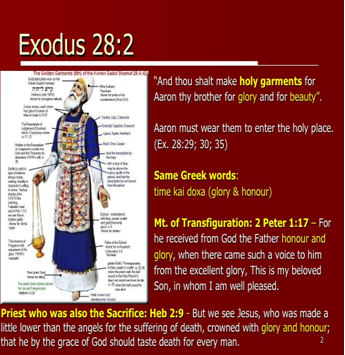
Exodus 28:3 explains that God had provided “gifted artisans” who were filled with the spirit of wisdom, so that they were able to make such beautiful garments. Later in Exodus we are told the actual names of these people who were chosen by God for this work. Nothing is left to chance with God.
Just consider this. The “Mishkan” was to be a temporary, moveable structure. The High Priest was wandering around the desert with all the others in the inevitable dust and grime which would accompany approximately 2 million souls and their livestock as they moved around the place where they were camped. For most of us, I think, temporary would mean, well, just that. But the place where God said He would meet with the High Priest was magnificent in appearance, and the High Priest was instructed to be dressed in the finest way possible.
Now, can we find a lesson for ourselves today in this? We worship the SAME God, a God who does not change. Do we concern ourselves about the way we present ourselves before Him when we meet with Him? Or will anything do? Are we particular about how we prepare ourselves to meet with Him? Our dress, our attitude, our conversation, our relationships with one another? Are we REALLY mindful of the awesome wonder and majesty of the One we seek to worship? Have we ever taken the time to ask Him about these things?
I sometimes get quite disturbed when I hear folk talk about Yeshua as “my friend”, but then speak of Him as though He were a ‘mate’. Almost contemptuously in a most familiar fashion. Well He IS our friend, but He is also our Saviour and worthy of all praise. Where today do we see that ‘reverential fear of Almighty God’? Doesn’t the Scripture tell us that ‘the fear of God is the beginning of wisdom’?
As we study the weekly parashah, understanding the relationship which God seeks to engender with these Israelites, we get the message that Almighty God is encouraging and training these people to be His special treasure. It seems that He has that desire to be loved, appreciated, honoured and obeyed. He seeks a people who will understand His Holiness and Majesty. The outward signs speak of His grandeur. The instructions are explicit. “Be ye Holy, as I am Holy” says the Lord. In the simplest of terms, to be ‘holy’ is to be different, to be separate. That is why these Priestly Garments were ‘holy garments’. They were different, special, separate from the normal.
May I suggest that this week, we ask Almighty God to show us how we can be “Holy” unto Him. The blessing will be yours.
Shabbat Shalom
RS
Terumah
Torah Portion for 7th February - 13th February
Torah portion Exodus 25 : 1 to 27 : 19
Haftarah portion 1 Kings 5 : 26 to 6: 13
“Offerings”
God’s Master Plan
Our parashah this week consists, principally, of a list of instructions regarding the building of the “Mishkan” (the Tabernacle).
To many of us this may be a rather uninteresting set of construction detail. But there is a great deal to learn by carefully observing the intricacy of these instructions. God did not allow for personal interpretation or human intervention in this matter. As we study this process we gain some valuable insights.
Firstly, there is the small matter of the materials to be used. Where on earth did this, now nomadic, horde of people get the materials which God specifically determined were to be used for this construction work? Well, go right back to Exodus 3:21.
“And I will give this people favour in the sight of the Egyptians; and it shall be, when you go, that you shall not go empty-handed.”
Then look at Exodus 12:36
And the LORD had given the people favour in the sight of the Egyptians, so that they granted them what they requested. Thus they plundered the Egyptians.
BEFORE the people even knew they were going to leave Egypt, God had planned the construction of the place where He would dwell amongst this people … and where the materials would come from!! Nothing was left to chance. God’s plan, and His planning is perfect. Be excited as you ponder the fact that our God does not change. (Malachi 3:6). Just as He cared for this ancient people, He cares for you too.
But there is a bit more to this. I want you to see the important part played by these Israelites in bringing God’s plan into being.
The instruction given to Moses was to inform the people of God’s plan.
The purpose of that plan is made clear in Exodus 25: 8.
“And let them make Me a sanctuary, that I may dwell among them.”
So the request, which is contained in Exodus 25:3 and the detail in the several verses which follow, is accompanied by an important condition. God specifically told Moses that acceptable offerings would ONLY be those “given willingly”.
The gold, silver and other precious materials were now in the hands of the Israelites. Those materials were theirs to keep. Moses had spoken an “invitation to contribute” to God’s plan, it was not a demand.
Ponder this carefully. God does not change. We are “invited” to participate in His plans. He has already provided the wherewithal. But it requires a willing heart (not grudgingly or of necessity (2 Cor 9:7)) to partner with God in that which He desires. No-one is conscripted by force. Every one of us has gifts and talents which are God given. It is both our privilege and honour to willingly participate in that to which God calls us.
The detail of this moveable Tabernacle is amazing. (Visitors to Israel might have an opportunity to visit one of the TWO replica Tabernacles which have been constructed there. The first, and smaller one, is in the desert at Timnah, in the area of Solomon’s Copper Mines, not too far from Eilat. The second, more elaborate replica, has been constructed (complete with light and sound spectacle) in the grounds of a hotel (Eshel Hashomron) on the outskirts of Ariel in Samaria. This hotel also has a most impressive Biblical Garden constructed in their grounds.)
As we proceed through the weekly readings from Torah, we will increasingly see the extremely important role which this Tabernacle plays in the life of the people, from their “wilderness wanderings” right up to the time that Joshua found a more permanent site for the Tabernacle at Shiloh in Samaria. (another Biblical site well worth a visit).
It was the place of residence of the Shekinah of the Lord. It was the place ordained by God where the transgressions of the people could find atonement. I wonder if you can see from the descriptions I have just written, that they are symbolic of another place (really another ONE) where the Shekinah of God is, where transgressions are pardoned, where lives are transformed. Where God is.
Yeshua Ha’Mashiach is vividly represented in God’s Master Plan, in the purposes and activities for which the Tabernacle of God was made.
Shabbat Shalom
RS
Mishpatim
Torah Portion for 31st January - 6th February
Torah portion Exodus 21 : 1 to 24 : 18
Haftarah portion Jeremiah 34 : 8-22 and 33: 25-26
"Judgements"
Promises, promises
Last week, although we did NOT ‘reflect’ upon it, we had the occasion of God giving Moses “THE TEN WORDS” (The ten commandments).
Immediately following this, as we begin to read this week’s parashah, we get into a lot of legal detail affecting the lifestyle choices faced by this ancient people. It is a very practical summary of behavioural issues surrounding the acquisition and treatment of slaves, loss of property, damage and loss caused by animals, murder, theft, bribery, perjury, and infidelity, before moving into the regulations regarding the “shemitta year”. Please note that the real purpose (see Exodus 23:11) of the ‘shemittah’ was to afford the opportunity for the poor amongst them, those who did not own land, to harvest whatever God provided from the residue of self seeded produce in the otherwise normally cultivated fields. This is also consistent with the purpose of the “tithe” described in Deuteronomy 14, so that the poor and the Levites were cared for in a natural way by the diligence of those who owned the land and its produce.
(This week is our first real encounter with what Christian teaching describes as “law”, which is then usually counter positioned against “grace”. In truth, it makes for difficult understanding in our culture 3,500 years later. For that reason it is not easy to draw practical lessons which are applicable to modern society. However, having said that, it is also true that the context falls precisely into the correct understanding of the meaning of the word “Torah”. These are God’s instructions (teaching) regarding righteously living together.)
There is more written about these legal issues in Leviticus, as they apply to the priestly class, and in Deuteronomy as they apply to the ‘laity”. Significantly, after laying down the ground rules regarding the weekly Shabbat, God gave Moses instructions regarding other remembrance festivals.
The Feast of Unleavened Bread in Exodus 12, was, of course in the context of Passover. In our parashah today, we have the first indication of the other festivals (called Pilgrimage Festivals) , which were to be remembered by annual attendance of the male members of each Tribe. Each of these remembrance festivals was to be celebrated in a place (later designated as Jerusalem) which God would specify. Take careful note that each of these annual festivals was to be celebrated, in part, by presenting gifts before the Lord. (How did the early ‘church leaders’ manage to miss that opportunity for a ‘gift day’? .. and that THREE times every year !!).
From Exodus 23:20, the tone changes. God’s promises contained here are spectacular. Take a moment to read from verse 20 to the end of chapter 23. There is very little comment required of me if you read it for yourself. An Angel of the Lord empowered by God. An Angel with lots of authority, but no discretion. Sent ONLY to do that which God had already commissioned. Amazing insight for me here. But look. There is a condition attached to those promises. It is undeniable, but there are people who, because of serious damage inflicted by abusive churches, cannot countenance the thought of being under such authority. Wasn’t it Samuel who later would say “obedience is better than sacrifice”? God says “Trust Me”. It is a truism, even today, that most of us seem to think we know better than a Holy God.
Chapter 24 concludes our parashah this week. On a previous occasion the people, as a group, had affirmed their allegiance to God’s instructions. Twice more in this chapter we read of their affirmation (verses 3 and 7) of acceptance of the instructions in “The Book of the Covenant”, which Moses read out to them. But in verse 7 they appear to go one step more with the addition of the words “and be obedient”. That word, translated “obedient” is the Hebrew word “Shema”. I conclude my ‘reflection’ this week by quoting, again, Rabbi Lord Jonathan Sacks, who provided this insightful meaning of “Shema”.
________________________________________________________________________________________________________________________________
“Shema Yisrael does not mean “Hear, O Israel”. It means something like:
Listen. Concentrate. Give the word of G-d your most focused attention. Strive to understand. Engage all your faculties, intellectual and emotional. Make His will your own. For what He commands you to do is not irrational or arbitrary but for your welfare, the welfare of your people, and ultimately for the benefit of all humanity.”
That, dear friends, is what these Israelites promised.
What is our promise to YHWH Elohim?
Shabbat Shalom
RS