
Reflections
REFLECTIONS ON THE WRITING PROPHETS
‘Reflections’ on the Writing Prophets 41
E Z E K I E L
The final “reflection” on the prophetic declarations of Ezekiel. Last week the focus was on the Temple yet to be constructed in Jerusalem, and the re-institution of the sacrificial system of worship in that Temple. I note a major difference between previous Temples and this third Temple. There is NO Court of Gentiles, with its accompanying “wall of partition”. The LORD says “No foreigner, uncircumcised in heart or uncircumcised in flesh, shall enter My sanctuary, including any foreigner who is among the children of Israel”. (Ezekiel 44:9) However, gentiles will be allowed to take up residence in the land, sharing that experience within one of the Tribes of Israel, living in peace and harmony with that Tribe (Ezekiel 47: 21-23). It is worthy of note that the sign of the covenant God made with Abraham was “circumcision of the flesh”.
In a previous “reflection” we dealt with the re-gathering of the Jews from “all the places where they had been scattered”. And now we consider the physical elements of settlement in the land for the Millennial kingdom of Messiah Yeshua.
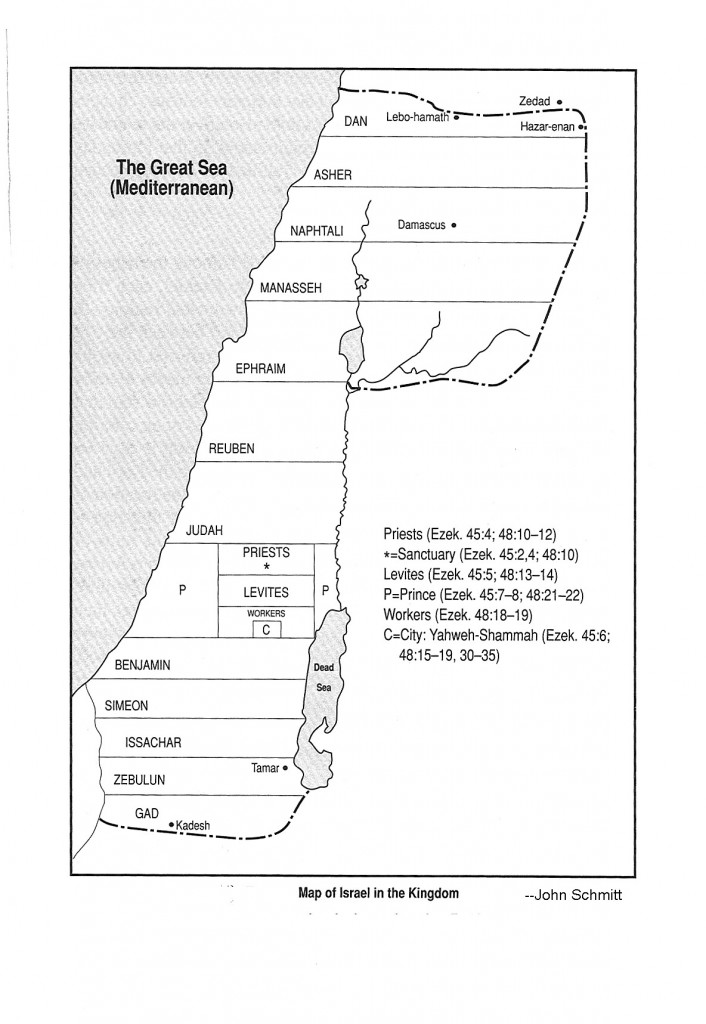
That ALL the tribes of Israel will be represented is beyond dispute because they are named. Among those will be the 144,000 young virginal men, who were “sealed” for special service of the LORD. From other Scriptures, we also know that those martyred during the period of tribulation leading up to “the war to end all wars” will be in positions of leadership, but not necessarily in Israel. (the world is a big place!!) The division of the land is much more ‘orderly’ than in the original settlement, (see illustration) and each tribe, except Levi, has a land allotment. Judah and Benjamin are immediately north and south of the central “Holy Zone”. That zone to be occupied by the Levites and the priests of Zadok, and adjacent land both east and west of the “Holy Zone” is allotted to “the Prince”. The Levites will be permitted to slaughter the sacrificial animals, but only the priests of Zadok will be allowed to enter the Holy Place where those sacrifices are presented to the LORD, for which duty they will be required to wear special linen garments to avoid the presence of any unclean bodily fluids such as sweat. And there will be strict rules of conduct, such as entry and exit procedures, for anyone attending the Temple courts. Having read the declarations of God given to Ezekiel, I have come to the view that the Millenial reign of Yeshua, ruling with a rod of iron (Rev 12:5 and 19:15) will be markedly different from the seeming chaotic mixture of activities we see in our present day world cities.
There will be other differences too. The Eastern Gate of the Temple, in present times is walled up and “guarded” by a very large cemetery all the way down into the Kidron Valley. In “Ezekiel’s Temple” that gate will be the way of entry of the LORD Himself. For that reason, no-one else is allowed to use it, and it will be closed for six days of the week. On Sabbaths, New Moons and other “mo’edim’ it will be opened. Only “the Prince” will be allowed to worship in the vestibule of this gate, and other people only at the entrance to that gateway, but not enter the vestibule.
Regarding the “mo’edim” of the LORD, there will also be changes to the present remembrances. Shavuot, Yom Teruah, and Yom Kippur will no longer be observed. Life will be under the New Covenant. Yeshua will have made His reappearance on this earth and the Day of Atonement will no longer be necessary. However, it is evident that as an everlasting memorial to Yeshua’s atoning death, and the miraculous birth of Israel as a nation before God, the celebration of Passover and Unleavened bread will continue. The joyous celebration of the Feast of Tabernacles (Ingathering), a remembrance of the marriage supper of the Lamb, will be an obligatory festival for ALL nations. This is clear from the word given to the prophet Zechariah, and nations unrepresented at that festival denied rainfall the following year.
The final observation to be made is the amazing revelation which God showed Ezekiel regarding the continuous flow of living water out of the new Temple. I confess that I find it impossible to imagine that scene. Truly a miracle of God. It will be a “river of life”. Ezekiel says “This water flows toward the eastern region (i.e, inland) goes down the valley, and enters the sea (the dead sea). When it reaches the sea, its waters are healed. And it shall be that every living thing that moves, wherever the rivers go, will live. There will be a very great multitude of fish, because these waters go there: for they will be healed, and everything will live wherever the river goes. It shall be that fishermen will stand by it from En Gedi to En Eglaim; there will be places for spreading their nets. This fish will be of the same kinds as the fish of the Great Sea (Mediterranean), exceedingly many”.
This is just part of the wonderful provision of God for those who, by faith and by action, are promised life with and in the Millennial reign of our Saviour. Blessed be His Name.
Shabbat Shalom
RS
Image Reference:
Source:
John W. Schmitt, Messianic Temple Ministries, 1633 SE 38th Portland, OR 97233
REFLECTIONS ON THE WRITING PROPHETS
‘Reflections’ on the Writing Prophets 40
E Z E K I E L
The first Temple, built by Solomon, was destroyed by the king of Babylon, Nebuchadnezzar. It was partially restored by Ezra and Nehemiah, and a new (second) Temple, built by Herod the great, took more than 50 years to construct, and was destroyed in 70 CE by Titus, son of Roman Emperor Vespasian. Following the prophecy about the return of the exiled Jews back to the land, and the “war to end all wars” which would bring nations into judgment with the LORD, Ezekiel is given a vision of another (third) Temple which is yet to be built in Jerusalem. As this present age draws to a close, the Scriptures tell us of the rise of “a man of peace” (identified as Anti-Christ). During his seven years of global influence he will demand to be worshipped in the Temple in Jerusalem. It does not yet exist! The dimensions of this visionary Temple occupy about 10 acres of land. The Temple Mount, is about 37 acres in area, and of trapezoid shape. Presently the site of TWO mosques. The Dome of the Rock (a memorial site to the prophet Mohammad), and the regularly used Al Aqsa mosque. The whole site presently under Jordanian administrators. Jews are not permitted to enter the site, but gentile visitors may get permission as tourists. (I have often wondered how a seven year peace treaty between Israel and the Palestinians might be forged by anyone. And then, in my imagination I see how the construction of a new Temple on the Temple Mount would be such an attractive proposition for Jews that such a peace treaty is quite possible)
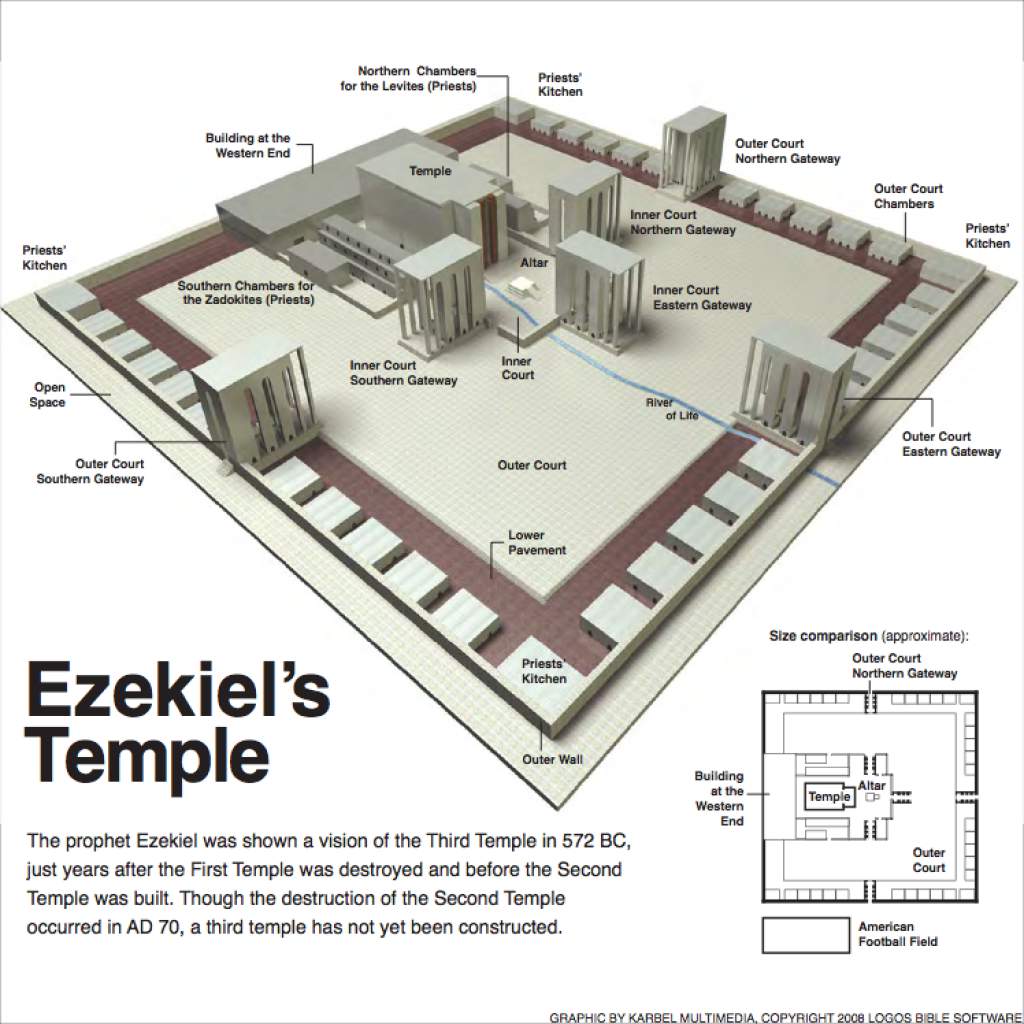
God took Ezekiel, in a vision, to a very high place, causing him to look to the south so that he could see clearly a structure ‘like a city’. There was a man in the gateway of that place, with a measuring line in his hand. The man spoke to Ezekiel. “Look with your eyes and hear with your ears, and fix your mind on everything I show you; for you were brought here so that I might show them to you . Declare to the house of Israel everything you see”. (That reminds me of the kind of instruction John was given as he was taken on his visionary tour of Heaven which is recorded in Revelation). In the first three chapters of our ‘reflection’ we find a detailed description of the Temple with many precise measurements of rooms, spaces, courtyards and steps. The descriptions of the Temple furniture and decorative features are also precisely specified. It appears as nothing was left to chance. It’s God’s way isn’t it? It is a most remarkable characteristic of our Bible. Sometimes a good search may be required, but God is fulfilling all His purposes just as He has declared in His Word. Trustworthy. And after the descriptions, Ezekiel was introduced to the purpose. The man spoke to Ezekiel again “Afterward he brought me to the gate, the gate that faces toward the east. And behold, the glory of the God of Israel came from the way of the east. His voice was like the sound of many waters; and the earth shone with His glory”. (Look again at Revelation 1:15) “And the glory of the LORD came into the Temple by way of the gate which faces toward the east”. Then the man who had been speaking to Ezekiel became silent and LORD Himself spoke again. “This is the place of My throne and the place of the soles of My feet, where I will dwell in the midst of the children of Israel for ever”. (Can you hear that voice like many waters?)
Now this is the challenge for believers today. Because of the anti Jewish bias of centuries of “church teaching”, there are many who cannot come to terms with the concept of another Temple being built. Especially a fully functioning Temple as was described in minute detail to Ezekiel. But there is MORE. Read for yourself Ezekiel 43:18-27. The last words read “When these days are over it shall be, on the eighth day and thereafter, that the priests shall offer your burnt offerings and your peace offerings on the altar; and I will accept you says the Lord God”. What Ezekiel is describing is a return to the sacrificial system of “drawing near to God” just as God had described to Moses on the mountain. For almost two thousand years, Jews have bemoaned the fact that they have no Temple in which to worship God. Unable to perform the daily rituals of sacrifice which Torah specifies. And here Ezekiel is describing the return of Burnt offerings, Sin offerings, Peace offerings. The only offerings not mentioned specifically are the Grain Offerings and the Trespass Offerings. It is demonstrably evident that God is fulfilling the prophetic return of Jews to Israel just as Ezekiel wrote. Did Ezekiel get it right in the first 39 chapters, and then get it wrong from chapter 40 to 48? I think not.
The Temple specified here will remain throughout the Millennial reign of Yeshua. A fully functioning Temple of worship, praise, adoration, and sacrifice to the Lord our God. Why? Because God has declared it. Now we need to also remember that life in that time will be different to the life we experience today. It will be life living in the New Covenant. The Torah of God will be put in the minds, and written on the hearts of men. No-one can be taught that, because everyone, from the greatest to the least will know it. Am I too bold to suggest we could start by observing it today?
Shabbat Shalom
RS
Image Reference:
Source:
Hubbard, Shiloh, Elliot Ritzema, Corbin Watkins, and Lazarus Wentz with Logos Bible Software and KarBel Media. Faithlife Study Bible Infographics. Bellingham, WA: Logos Bible Software, 2012.
REFLECTIONS ON THE WRITING PROPHETS
‘Reflections’ on the Writing Prophets 39
E Z E K I E L
Very serious message to ‘reflect’ on this week. The war to end all wars, a future event. Ezekiel is instructed to prophesy against more enemies of Israel. The first mention of the name “Gog” appears in 1 Chronicles 5:4, the genealogy of Reuben. However, there are many who still argue about the identity and origins of the “Gog” (be it man or nationality), who (or which) is the main subject of this week’s ‘reflection’. What is abundantly clear is that Almighty God is against Gog! Identified as an enemy whom God will encourage to enter into battle with Israel, and then be defeated. The prophecy remains unfulfilled. Many believers look for the signs of that fulfilment because, importantly, it heralds the beginning of the end of this age, immediately preceding the return of Messiah Yeshua to rule and reign in Jerusalem for 1,000 years. And that is what the Scriptures are all about.
(Reference is made to Rosh, Meshech and Tubal. It is of little consequence to the events of this ‘reflection’, but “rosh” is a Hebrew adjective mentioned over 600 times in the Scriptures and always interpreted “chief”. It is not a description of territory, as Meshech and Tubal are identified as regional areas of present day Turkey. So, Gog is the ‘chief prince of Magog’. It is a matter of further interest that Gog and Magog rate an important mention again AFTER the millennial reign of Yeshua in Revelation 20, when Satan is released from the “prison” in which he will be chained. Gog and Magog are identified as ‘the four corners of the earth’. In that final battle, God uses fire to consume His enemies).
Then Ezekiel turned his attention to the battle plan God has devised. “Prepare yourself and be ready, you and all your companies that are gathered about you: and be a guard for them. After many days you will be visited (one might assume this to be by provocation of the Spirit of God). In the latter years you will come into the land of those brought back from the sword and gathered from the many people on the mountains of Israel, which had long been desolate; (remember the 1,800 years of drought which caused that desolation which we mentioned last week) they were brought out of the nations and now dwell safely.” To gain the timing perspective I carefully note that for at least 200 years Israel was occupied by the Greek and Roman invaders before Yeshua came to this earth. Then only in 1948 was Israel established again as a sovereign nation, and just in the last 70 years have we observed the enormous rates of immigration by Jews back to the land. So the invaders, when they appear as a great army of many nations, thinking it to be an easy task, complacent, ill prepared, contemplating a quick end to the battle, are in for a mighty shock. God said “Surely in that day there shall be a great earthquake in the land of Israel ….. and all the men who are on the face of the earth shall shake at My presence. Thus I will magnify Myself and sanctify Myself, and I will be known in the eyes of many nations. Then they shall know that I am the LORD." As this present age draws to a close, God is intent on revealing Himself to the world in a manner that leaves no doubt about Who He is. The days of optional opinions of Him will be behind us. His mighty arm exposed and demonstrated for all to see. No longer will “faith” be required to trust Him. Because they will ALL know Him, from the greatest to the least. This is the time generally known by believers as “the Ezekiel 38/39 war”. This is also consistent with the account of the breaking of the sixth seal described in Revelation 6:12-16.
Our “reflection" continues as Ezekiel speaks in prophecy to that great army. “You shall fall on the mountains of Israel, you and all your troops and the people who are with you; I will give you to birds of prey of every sort and to the beasts of the field to be devoured”. The description of the carnage which this battle produces is unprecedented. Read the description in Chapter 39 of our text. The invading armies are reduced, in death, to become a gigantic food lot for birds and wild animals. Horrific. “So I will make My holy name known in the midst of My people Israel, and I will not let them profane My holy name any more. Then the nations shall know that I am the LORD, the Holy One of Israel”. Then in emphatic terms He continued “Surely it is coming, and it shall be done,” says the Lord God, “This is the day of which I have spoken”. Now, as I write this “reflection”, I perceive that there are only TWO groups of people alive in this world today. There are those of us who trust and believe God, and there are others who do not. There is NO fence to sit on. But what I believe, and others may not, has NO bearing on the veracity of God’s plan. It is set out in plain and simple language. Make a choice. The future of every person is decided by the choice made.
The prophecy of Ezekiel declares that such will be the scale of the slaughter that it will take seven months for the whole land to be cleared of the remains of the dead, so that the land will be cleansed. A time which I presume will be part of the first year of the millennial reign of Yeshua, which immediately follows this “war to end all wars”. It is the time when the Apostle Paul declares that “All Israel shall be saved” (Romans 11:26). What God says is “When I have brought them back from the peoples and gathered them out of their enemies lands, and am hallowed in them in the sight of many nations, then they shall know that I am the LORD their God, who sent the into captivity among the nations, but also brought them back to their land, and left none of them captive any longer. And I will not hide My face from them anymore; for I shall have poured out My Spirit on the house of Israel, says the Lord God”.
There could not possibly be a more clear declaration of the love of God for those who are preciously ‘called by His name’.
Shabbat Shalom
RS
REFLECTIONS ON THE WRITING PROPHETS
‘Reflections’ on the Writing Prophets 38
E Z E K I E L
The nature of the prophetic message given to Ezekiel changes dramatically. We ended last week with exile from the land imminent, and future desolation prophesied. And so it was. In the event, approximately 1,800 years of debilitating drought, causing catastrophic desolation. And there remain serious issues with the “shepherds of Israel”. Those who should have been leading the people into safety, feeding them properly, spiritually, with the teachings given to Moses on the mountain centuries earlier. “Thus says the Lord GOD: ‘Behold, I am against the shepherds (of Israel), and I will require MY flock at their hand; I will cause them to cease feeding the sheep, and the shepherds shall feed themselves no more; for I will deliver My flock from their mouths, that they may no longer be food for them’.” Blunt, direct, unambiguous, final. Those appointed by God to be teachers and leaders are subject to a stricter judgment than those who are not (James 3:1). It was true in Ezekiel’s day, and it is true today. The penalty for leading people falsely, or selfishly, by seeking gain for oneself at the expense of the ‘flock’, is frightening. Yet, even today, hierarchical church structures, operating on the classic modern business model, are rife with it. In His letters to the “ekklesia” in Revelation, Yeshua described it as the “doctrine of the Nicolaitans”, which He hates.
The people had been scattered as a result of the neglect (for which God blamed the shepherds) of their covenant responsibilities. Firstly, they were exiled to Babylon, and from there, many returned about 70 years later. But this prophetic announcement of Ezekiel goes way beyond that exile. “Indeed I Myself will search for My sheep and seek them out … and deliver them from all the places where they were scattered on a cloudy and dark day … and will bring them to their own land”. And that prophecy, my dear friends, we see being fulfilled before our own eyes in this generation. Consider this. No country can prosper without rain, and God controls the weather. After the exile by the Romans, Israel did not begin to have any meaningful rain again until about 1878. (In 1867, Mark Twain, in his book “Innocents Abroad” had described the country as “desolate and uninhabitable”). Then in 1897, Theodore Hertzl, at the age of 37 years, organised the first Zionist Council in Basel Switzerland. He died 7 years later, but the return of Jews to the Land had now began. In 1947, the United Nations agreed to grant Israel rights to the Land again. That very year, rainfall reached a new level. Another peak in 1967, when Jerusalem was restored to Israel. In 1973, when Israel successfully fought off the challenge of the “Yom Kippur” war, another rainfall peak occurred. In 2020, the ‘Sea of Galilee’ was a mere 21 cm below its ‘dangerous’ red line level, causing the authorities to contemplate opening the dam to release water from it!! AND, Jews “making Alyia” (going up) to Israel continued unabated. This friends, is what the LORD showed Ezekiel in our prophetic reading today. What a mighty God we serve. “I will establish one shepherd over them, and he shall feed them - My servant David. He shall feed them and be their shepherd”. Now clearly, king David had died about 400 years earlier. But his dynasty was established ‘for ever’ (2 Samuel 7: 12 -16). An unmistakable reference to Messiah Yeshua, and an event still future to us today. But there is MORE. “I will make a covenant of peace with them”. This is the NEW COVENANT, sealed with the ‘Blood of the Lamb’ which Jeremiah detailed, and which is to be made with ‘the house of Israel and the house of Judah’. (Jeremiah 31: 31-34) Gentiles may be included in that covenant by “grafting in” as Paul described in Romans 11. And that my dear friends, has privileges and responsibilities!! “Thus they shall know that I, the LORD their God, am with them, and they, the house of Israel, are My people”. It seems that God is focussed on ensuring that both by His own people, and by the world, that HE alone is known as God, and there is no other.
This whole theme of restoration of the scattered people of Israel to the land of God’s promise to Abraham, Isaac and Jacob, and His reason for so doing, is continued in Chapter 36. “Thus says the Lord GOD; ‘I do not do this for your sake, O house of Israel, but for My holy name’s sake, which you have profaned among the nations wherever you went …. And the nations shall know that I am the LORD … when I am hallowed in you before their eyes’.” It is a work in progress. A population of about 800,000 in 1948 has become 9,250,000 in 2020. Can anyone deny that God is fulfilling the prophecy of Ezekiel? ALL of it in my lifetime. And it is not finished. There are still about 6 million Jews not living in Israel. And a very small proportion of Jews have faith in Yeshua as Messiah. And so we come to the amazing prophetic message of Ezekiel 37. DRY BONES. “Can these bones live?” Ezekiel answered “O Lord GOD, You know”. Please read the prophetic words of Chapter 37 again, understanding that the process has already begun.
The nations of Israel and Judah, separate at the time when Ezekiel lived, are to “become one stick” again (v 19), as they were under the rule of king David. They will be ONE nation again, never to be divided (v 22). They will be ruled by the dynasty of David (Messiah Yeshua) (v 24). They will be united in Torah observance (v 24). And they will have a “New Covenant”. “The nations will know that I, the LORD, sanctify Israel, when My sanctuaries in their midst forevermore”.
The question that remains in my mind is .. why are believers in Yeshua today so ignorant of God’s eternal plan for His people, Israel? It is unfolding before our eyes.
Shabbat Shalom
RS
REFLECTIONS ON THE WRITING PROPHETS
‘Reflections’ on the Writing Prophets 37
E Z E K I E L
The prophecy against Egypt (587 BCE by the date given to us by Ezekiel). Ezekiel had been taken captive into Babylon about 15 years earlier. Nebuchadnezzar’s army was just beginning their siege of Jerusalem. Egypt had been a world power for centuries and had prospered under the stewardship of Joseph when he was Prime Minister. Several years later, following his death, the prosperity continued for Egypt with the availability of an abundance of Israelite ‘slave labour’. Now Ezekiel was shown events which would soon follow for Egypt, and God would use first the Greeks (570 BCE), and then the same armies which were besieging Jerusalem (567 BCE) to bring judgement on the Egyptians. The Pharaoh was described as a ‘crocodile’, a mean cruel monster, which was once revered by Egyptians, but living in the rivers where Egyptians fished for food. Additionally, Israel had unwisely relied on Egypt in a military alliance, and been let down. “Then all the inhabitants of Egypt shall know that I am the LORD, because they have been a staff of reed (very weak) to the house of Israel (Isaiah 36:6). When they took hold of you with the hand, you broke and tore all their shoulders (turned on them), when they leaned on you, you broke and made all their backs quiver”. For that, God said He would make Egypt “desolate and waste”. And He did. But as a God of mercy and compassion, that was not the end for the people. “At the end of forty years .. I will bring back the captives of Egypt and cause them to return to the land of their origin, and there they shall be the lowliest of kingdoms .. so they will not rule over the nations anymore”. And they never have. The lesson for us? What God says, God will do!
In a very interesting twist, it seems to me, God had determined to reward the army of Nebuchadnezzar, for their help in bringing judgement upon Judah!! They had toiled for about 13 years in siege of Tyre as their reward, but were unsuccessful. The people of Tyre escaped to an Island and survived. “Therefore thus says the Lord GOD: ‘Surely I will give the land of Egypt to Nebuchadnezzar king of Babylon; he shall take away her wealth, carry off her spoil and remove her pillage; and that will be the wages for his army. I have given him the land of Egypt for his labour, because he worked for Me.’ Says the Lord GOD”. God is no-one’s debtor.
The prophecy against Egypt continued, and as our reading progresses we see that other nations are drawn into the net of God’s wrath. Ethiopia, Libya, Lydia, Chub. Nations who supported, and had citizens working with, Egypt are all drawn into the net. “Those who uphold Egypt shall fall”, we are told. And here is perhaps another lesson for us today. We need to take great care to whom, and what, we support and provide aid. Because when God looks upon those who are His, He expects that we will not give our support to those who oppose Him. Certainly not those who are false teachers. Our God is a jealous God. Double standards will not be tolerated in any circumstance. One cannot support what God condemns. To do so is to be subject to the same condemnation. Then Ezekiel is told the reason for all this wrath AGAIN. “That they shall know that I am the LORD”. It is a recurring theme of God. When He instructed Moses to proclaim the curses which befell the Pharaoh of Egypt in his day, it was so that “they shall know that I am the LORD”. And because we are already blessed with the knowledge of Him. We are without excuse.
In Chapter 33 of our text, God returns to the message He first gave Ezekiel in Chapter 3. It is a message we should all learn. It is the role of “watchman”. It doesn’t sound too arduous, but it is viewed with great importance by God. In Chapter 3, God appointed Ezekiel as “watchman” for the house of Israel. Here in Chapter 33, God instructed Ezekiel to appoint other “watchmen”, with identical responsibility and consequence. It is a simple task. When danger appears, blow the trumpet to warn the people. It is what Ezekiel is doing in writing this prophetic book. Those who heed the warning will be saved from the danger. They take action themselves to be protected. But if the warning is deliberately ignored, then they take the consequential responsibility themselves. However, if the “watchman” does NOT sound the warning, he bears the consequential responsibility for his lack of action. I note that there is NO middle ground. It is concisely set out for us as God told Ezekiel “I have no pleasure in the death of the wicked, but that the wicked turn from his way and live. Turn, turn from your evil ways! For why should you die, O house of Israel?” Good question eh? Selah!
Our ‘reflection’ ends this week with a sad reminder that the Israelites did not heed the warning of the “watchmen”, and were taken, as a nation, into captivity in Babylon. But we know they were restored, in part, about 70 years later, when first Ezra, then Nehemiah, returned to rebuild the walls of Jerusalem. So it comes as a surprise to see the prophecy in Ezekiel 33: 28 about the “desolation of the land”. This is a reference to another exile which took place when the Romans, in 135 CE expelled the Jews after the Bar Kochba uprising, and the siege at Masada. It is noteworthy that the land of Israel endured about 1,800 years of drought after that event. In 1867, the American author, Mark Twain, in his book “Innocents Abroad” wrote that the land, then known as Palestine, was a land “desolate and uninhabitable”. There was no meaningful rain there until about 1880! And today, Israel has an annual rainfall of approx. 600 mm. As we anticipate our “reflection” of next week, we will see how that is so important in God’s plan for those who are called by His name.
Shabbat Shalom
RS
REFLECTIONS ON THE WRITING PROPHETS
‘Reflections’ on the Writing Prophets 36
E Z E K I E L
In a graphical, picturesque way, God spoke to Ezekiel about the abominations with which the Israelites had defiled themselves. Going back to their time in Egypt, as slaves, God identified the roots of their defilement. He used the example of two sisters to describe the downfall of both Israel and Judah (for which He uses the name of their capital city, Jerusalem). He might have expected that the sister “Oholibah” (Jerusalem) would have learned from the calamity which befell “Oholah” (Samaria). But the malady was deep seated, and had to be removed. Chapter 23 is quite descriptive, and requires no further comment to gain the impression of the disgust with which God viewed their behaviour, and for which He could no longer withhold judgment.
Ezekiel is specific about dating his revelations from the LORD. The dates commence (Ezekiel 1:2) from the reign of Judah’s king Jehoiachin. So the Ezekiel 24 encounter is set in 588 BCE, when the 18 month siege of Jerusalem began. The parable of the boiling pot is another graphic picture of a time of misery for the Judeans as they suffer the siege of Nebuchadnezzar. After the people are dealt with, the “pot” (Jerusalem) itself, is ruined in the fire. “It shall come to pass, and I will do it; I will not hold back, nor will I spare, nor will I relent; and according to your deeds they will judge you”. God told Ezekiel that he was not to mourn or weep over His judgement. Then in an almost unbelievable manner, Ezekiel says he told the people the message of God in the morning, and that very evening his own wife died! Did the LORD take away his natural sorrow supernaturally? We will never know. But what we do know is that Ezekiel was faithful to his allotted task, and became an example to the people. “Thus Ezekiel is a sign to you; according to all that he has done you shall do; and when this comes, you shall know that I am the Lord GOD”.
The “lamentations” continue. Ezekiel 25 records the words of the LORD against those who dealt spitefully with Israel. Turn your mind back to the promise God made to Abraham in Genesis 12:3. “I will (bitterly) curse (Heb. a’rar) those who (treat with contempt) curse (Heb. qalal) you”. So it is that we find Ezekiel instructed to prophesy the events which are to be visited on the Ammonites, and the inhabitants of Moab and Seir. They would scoff and ridicule the Judeans. Edom is mentioned again. The Philistines and the Cherethites, Tyre, Sidon. All the nations and groups who ‘treated Israel with contempt’ come under the judgement of the LORD for their actions. Because God described the Israelites as “My special treasure”, and “the apple of My eye”, those who ignore that relationship do so at their peril. And Ezekiel is chosen by God to reinforce that message. “Hear the word of the Lord GOD! Thus says the Lord GOD: ‘Because you said “Aha!’ Against My sanctuary when it was profaned, and against the land of Israel when it was desolate, and against the house of Judah when it went into captivity, indeed therefore I will deliver you as a possession to the men of the East etc. etc”. The Philistines too because “they dealt vengefully and took vengeance with a spiteful heart, to destroy because of the old hatred”. And don’t we see that in evidence today in many nations of the world. Curiously, to me, whereas God was bringing judgement on the Israelites because of their neglect of Torah, in many places, especially among some Christians, the ‘hatred’ seems to be because the Jews overtly uphold the Torah!! Work that out if you can.
We sometimes forget that whilst God is certainly concerned with the land of Israel because of His special relationship to the Jews, He actually commands the destiny of ALL nations. “For all the earth is Mine” (Exodus 19:5). It was His then, and it is His now, albeit temporarily the disobedient are under the influence of the “prince of the power of the air” (Ephesians 2:2). But that does not provide an acceptable excuse, before God, for behaviours which are detrimental to His beloved nation. Ezekiel is given a list of the detractors. Babylon heads the list, Ammonites, cities of Moab and Seir, Edom, the Philistines, citizens of Tyre, Sidon, Persia, Lydia, Libya, Syria all get a mention. And dear friends, I suspect that if Ezekiel were delivering that prophetic message today, there would be many more. To our great shame, well known names of countries and people groups joining that list. The word of the LORD still applies. “Because you have set your heart as the heart of a god, behold, therefore, I will bring strangers against you, the most terrible of nations; and they shall draw their swords against the beauty of your wisdom, and defile your splendour. They shall throw you down into the Pit, and you shall die the death of the slain in the midst of the seas”. I speculate here as I see in my mind, the cruel destructive hand of Islam as a possible agent of the LORD is bringing judgement on nations which have been, for many centuries, enemies and detractors of the dispersed of Israel!
Well the last word, as always, must go to the LORD Himself. “When I have gathered the house of Israel from the peoples among whom they are scattered, and am hallowed in them in the sight of the Gentiles, then they will dwell in their own land which I gave to My servant Jacob. And they will dwell safely there, build houses, and plant vineyards; yes, they will dwell securely, when I execute judgements on all those around them who despise them. Then they shall know that I am the LORD their God”.
That re-gathering is taking place in our generation. It is a sign that we are at the beginning of the end. I pray that those who claim to be “on the LORD’s side”, will join Him in being on Israel’s side too.
Shabbat Shalom
RS
REFLECTIONS ON THE WRITING PROPHETS
‘Reflections’ on the Writing Prophets 35
E Z E K I E L
A ‘lament’ is a verbal expression of grief. God required Ezekiel to pronounce such a deep regret. It is historical. It’s about the past. But as is often the case, the past determines the future. So it was for the southern kingdom of Judah, The ‘mother’ refers to the nation, Judah. The ‘lions’ refer to her recent kings. All of them “bad” kings. Specifically, Jehoahaz, who only reigned for 3 months in 609 BCE, overthrown by Egypt’s Pharaoh Necho. Then Jehoiachin, unjust and cruel, who also only had a 3 month reign before being carried off to Babylon in a cage (2 Kings 24:6-15) in 597 BCE. He was held captive for 37 years. And finally, Zedekiah, bringing about the collapse of the Davidic dynasty in 586 BCE. By his treachery, he was responsible for the burning down of Jerusalem. But as to the future, the Davidic dynasty will be restored when Messiah Yeshua returns to sit on that throne.
In Ezekiel 14 we pondered the question “Should I let Myself be enquired of at all by them?” Which the LORD put to Ezekiel (a question which brought enormous challenge to my life, see “reflection” 33). Now the LORD is quite specific when some of the elders came to enquire of Him. “I will not be inquired of by you”. But He told Ezekiel to “Judge them, and make known to them the abominations of their fathers”. Abominations which evidently were continued by them. Hence the judgment. So it was that again God spoke to Ezekiel about the blessings He had promised to the Israelites. Bringing them out of slavery in Egypt. Giving them their own land which He described as “a land that I had searched out for them, ‘flowing with milk and honey’, the glory of all lands”. Not any land. The best that existed. And as He continued, we find an expression which provides a salutary lesson for each of us. “Yet the house of Israel rebelled against Me in the wilderness; they did not walk in My statutes; they despised My judgments, which if a man does, he shall live by them”. Remember Malachi 3:6. “I am the LORD, I do not change”. So here is the lesson. There are NOT some rules for one, and different rules for others. For the Israelites, Deuteronomy 28,29 spelled out the blessings (for the obedient) and the ‘curses’ (for others). Those curses are activated by mans own choices. They are stated clearly upfront. No ambiguity. What Ezekiel was being told to say was already known by the Israelites. It was not a mystery. But that did not make any more palatable either. As we said earlier in this ‘reflection’ “the past (or even for us the present) determines our future”. That is an unambiguous fact of Scripture, proclaimed here by the prophet Ezekiel. “I am the LORD your God: Walk in My statutes, keep My judgements, and do them; hallow My Sabbaths, and they will be a sign between Me and you, that you may know that I am the LORD your God”. Selah!
It must have been heartrending for Ezekiel to bring the words of the LORD to the people. He was one of them. He was captive in Babylon at the time. He is told to tell the people that a sword is already prepared, sharpened, polished, waiting to bring destruction to Jerusalem. Dreams turned into nightmares. As Nebuchadnezzar, king of Babylon prepared to go to battle, it seemed that he had two places to invade. Ezekiel is shown the alternatives. Rabbah of the Ammonites and Judah, where Jerusalem was fortified. At the junction of the two ways, a decision had to be made. Nebuchadnezzar turned to ‘divination’ for direction. But, Ezekiel knew that God Almighty was in control, because He told him so. The Judeans thought it was a false divination. That it would not happen. Speaking of Zedekiah, God said “Now to you, O profane, wicked prince of Israel, whose day has come, whose iniquity shall end, thus says the LORD ‘Remove the turban, and take off the crown; nothing shall remain the same”. God’s judgment cannot be stayed. It is as inevitable as night follows day. The Judeans did not believe it. And my dear friends, many, even those who claim allegiance to our God, do not believe it. (Matthew 7:21) It would be good to read again, from Ezekiel 3 and 33, the role we have as watchmen. It is an onerous duty to be called as a modern day Ezekiel.
As we near the end of this ‘reflection’, God, repetitiously, calls Ezekiel to be a judge. Pointing out over and again the abominations which caused Him to act against the people called by His name. Why? Why now? As I pondered this thought, it came to me that the abominable actions of people called by God’s own name, could not continue because of the damage being done to His NAME. God was effectively being mocked. He had intended the Israelites to be an example for good in the world. As He does US. Instead God’s very name was brought into disrepute. Pray that we are not guilty of the same offence, not by what we say, but by the way we live our lives before men. That was the ultimate sin of the Israelites. They belonged to the LORD, but acted as though they did not. The result for them? “I will scatter you among there nations, disperse you throughout the countries, and remove your filthiness completely from you. You shall defile yourself in the sight of the nations; then you shall know that I am the LORD”.
The people were about to experience the fire of the LORD. “I sought for a man among them who would make a wall, and stand in the gap before Me on behalf of the land, that I should not destroy it; but I found no-one”. How sad. God looks, in every generation, for those who will ‘stand in the gap’ before Him. In our generation we have been called for that purpose. God grant that we diligently seek His face to understand the role He has allotted us to accomplish in His Name, by living righteously before men. May you find blessing in so doing.
Shabbat Shalom
RS
REFLECTIONS ON THE WRITING PROPHETS
‘Reflections’ on the Writing Prophets 34
E Z E K I E L
The tone of God’s judgement against Judah appears to change. It was lack of attention to the covenant, to which they had agreed, which had been the focus of complaint against them. The idolatry, the rebellion, the defiance, and the attitude, which caused the anger of the LORD to be directed against them. The metaphor of the wood of the vine, useful for the purpose of bearing fruit, and for no other practical purpose, is graphic. When its fruit bearing is finished it is burned in the fire. Judah, indeed the whole of Israel, is likened to the wood of the vine. God chose them, nurtured them, raised them, for that very purpose. The ‘reflection’ Scriptures this week start with a bit of a history lesson for them. The first 7 verses of chapter 16 contain a survey of the time from Abraham to their departure from Egypt. The time when God was preparing them to be the “special treasure”, He had promised Abraham they were to be. The manifestation of that role was to come when they entered the land God had promised them. The language in our text is graphically descriptive. From an unattractive ‘waif’ to a ‘beautiful queen’. And now, some 800 years later, Judah, the southern kingdom, was about to feel the hot breath of God’s chastisement for their misdemeanours. Just as Israel, in the north, had done 120 years earlier. Humiliating exile from the land. A quite sad commentary. From “queen” to “waif” again. Is there a lesson for us in that? Am I the man God expected me to be when He called me into His service? Selah!
What had happened to these ‘chosen people’? Ezekiel continued the narrative. God blessed them abundantly. They began to understand and appreciate that there were safe arms of love and protection around them. Their enemies seemed to be powerless against them. Yes, they suffered some defeats, but were not overwhelmed. Until now. What had changed? Put as simplistically as it possibly can be, they took God’s protection for granted. In so doing, they forgot the most solemn promises of God (Deuteronomy 28,29) which required that they had an important role to fulfil, in order to enjoy the continuation of God’s unfailing blessing. There is a parallel we might make here. Their salvation, like ours, was freely provided for by our God. When they painted the blood of the Passover lamb on the doorposts of their houses, their salvation was assured. When we put our faith and trust in the finished work of Messiah Yeshua, our salvation is assured. We enter into covenant with God. The Apostle John quoted Yeshua Himself when referring to the way we would be identified as His disciples. “If you love Me, you will keep My commandments”. That’s right, it’s that clear. That’s the same Yeshua who was “In the beginning”. (John 1:1) Taking Him for granted leads to a perilous outcome. Take time to read Matthew 7 : 20-23. ‘Lawlessness’ is a Greek translation of“Torahlessness”.
Ezekiel does not mince words. Chapter 16 describes the spiritual immorality of Judah. Comparisons are made with Samaria (the northern kingdom), with Sodom (completely removed from sight). Even the women of the Philistines were abhorred by their behaviour. “Now then, O harlot, hear the word of the LORD! Thus says the Lord GOD: Because your filthiness was poured ourt and your nakedness uncovered in your harlotry with your lovers, and with all your abominable idols, and because of the blood of your children which you gave to them, surely therefore, I will gather all your lovers with whom you took pleasure, all this you loved, and all those you hated; I will gather them from all around against you and will uncover your nakedness to them, that they may see all your nakedness”. Devastating humiliation before all those to whom God expected they would be an good example.
It sounds as though God was finished with them for ever doesn’t it? He had every right to be angry, and we have good reason to expect that they would experience the curses which follow disobedience to their covenant. Otherwise how can we have trust in His promises to us? But God had not finished what He wanted to tell them. “For thus says the Lord GOD: I will deal with you as you have done, who despised the oath by breaking the covenant. Never- the- less I will remember My covenant with you in the days of your youth, and I will establish an everlasting covenant with you. … Then you shall know that I am the LORD”. That covenant, when it is made, will be unbreakable. “Not according to the covenant I made with their fathers”. (Jeremiah 31:31) And it will have the same Torah as the one they broke!
God then told a ‘parable’ for the people to consider. The parable of the two eagles. The first referred to the king of Babylon, who prevailed against Judah. The second eagle refers to Judah’s last king, Zedekiah, who turned to Egypt for help against the invasion of the Babylonians. That plan turned against them, and they ended up with two enemies! Two eagles instead of just one.
Our reading comes to an end on a note of great comfort. There is redemption for anyone who acts in accordance with the covenant they make. “Behold, all souls are Mine; the soul of the fathers well as the soul of the son is Mine; the soul who sins shall die. But if a man is just and does what is lawful and right; … If he has walked in My statutes and kept My judgements fait“hfully - he is just; he shall surely live! Says the Lord GOD”.
Our God is a covenant keeping God. Righteous. Upright. Just.
Shabbat Shalom
RS
REFLECTIONS ON THE WRITING PROPHETS
‘Reflections’ on the Writing Prophets 33
E Z E K I E L
The LORD had shown Ezekiel, in visions, the wickedness and rebellion of the people. It continued further by revelation of 25 people, leaders no less, who were stirring the people up to fight against the insurmountable might of the armies of Babylon. They described the people as “meat in a cauldron”, from which there was no escape. By engaging in battle, many would unnecessarily lose their lives. In contrast, the prophet Jeremiah, also a priest, had counselled the people to go quietly, to avoid losing their lives in battle, and trust the LORD to bring them back (Jer 27:9-17). Ezekiel cried out to the LORD. “Ah, LORD God! Will You make a complete end of the remnant of Israel?” The LORD replied with words which are of immense comfort. They form part of a major theme of the prophetic message of Ezekiel, which is the faithfulness of God in keeping covenant with His people. That does not in any way diminish His anger at their disobedience, or reflect change in His attitude to their idolatry. “Although I have cast them far off among the gentiles, and although I have scattered them among the countries, yet I shall be a little sanctuary for them in the countries where they have gone”.
The hostility was from Babylon, and that is where the vast majority were exiled. But it would appear that many others did not wait for that invasion, but took opportunity to escape to other neighbouring lands, even some very far away. The promise of the LORD to “be a little sanctuary” speaks of those who remain faithful in their observances and remembrances of the love, grace, and mercy of Him throughout their generations, even in foreign places. (It is notable that, with no temple available to them, the ‘synagogue’ as a place of worship and praise arose from that exile in Babylon. It is a characteristic of Jewish people to this very day. Readily identified in any community.) And in unambiguous language, the LORD continued “I will gather you from the peoples, assemble you from the countries where you have been scattered, and I will give you the land of Israel”. The covenant promise of the land, previously made with the patriarchs, Abraham, Isaac, and Jacob, is hereby verified yet again, to the people who are about to be exiled from the land. That’s the good news. But the LORD also said “None of My words will be postponed any more, but the word which I speak will be done”.
There is damning evidence of the deception which some “prophets” in the community had sought to elevate themselves in the eyes of the people. Claiming to speak in the name of the LORD. “You say, ‘The LORD says,’ but I have not spoken”. There is a huge lesson for us today right here. When anyone uses the words “The LORD told me” or similar, it is almost invariably used as a conversation stopper. The exact opposite is a better response. “How did the LORD speak to you?” would be better. As believers we have a responsibility to ‘test the spirits’. Do not be deceived, as were these people of Judah, by words spoken in the name of the LORD, when He has not spoken such words. The test? God will not speak anything which is contrary to His written word. “My hand will be against the prophets who vision futility and who divine lies; they shall not be in the assembly of My people, nor be written in the record of the house of Israel. Then you shall know that I am the LORD God”. God used the example of a wall plastered with untempered mortar. When the rains came, the facade was washed away and the foundations exposed. Falsity. Ambitions of the fakes. Exposed for all to see.
Ezekiel then related an incident which the LORD used to speak directly into my heart several years ago. I was lying in a hospital bed at the time, immobilised. Trust me when I say that I was praying long and often for the LORD to heal me. It is quite personal to me, and it changed my life. YES, I am SURE it was the LORD who spoke. Some elders of Israel had come to enquire, to seek some counsel, from Ezekiel the priest. Read the story very carefully yourself (Ezekiel 14). The LORD revealed to Ezekiel that these ‘elders’ had “set up idols in their hearts, and put before them that which causes them to stumble into iniquity”. Then the body blow. “Should I let Myself be inquired of at all by them?” Was the LORD saying that there are some (me specifically) that He was questioning if their requests should be heard? That my prayers were blocked from Him? That He was not even willing to hear about my pain? My inability to move? The good news for me was that God used that to change me, and to bring about my recovery. But MORE than that, I learned that God speaks through His word TODAY. All it takes is a desire to listen. “For anyone of the house of Israel, or of the strangers who dwell in Israel, who separates from Me and sets up his idols in his heart and puts before him what causes him to stumble into iniquity, then comes to a prophet to enquire of him concerning Me, I the LORD will answer him by Myself”. Everyone of us is answerable directly to the LORD. Selah!
Finally, for this ‘reflection’, Ezekiel was told “When a land sins against me by persistent unfaithfulness, I will stretch out My hand against it”. Nations are to receive the judgment of the LORD according to their faithfulness to the LORD whose land it is. All the world is His. But there is hope for individuals living in such faithless lands. “Even if Noah, Daniel and Job were in it (Jeremiah adds Moses and Samuel to that short list (Jer 15:1)) they would deliver only themselves by their righteousness”.
There is always a remnant. People who remain faithful. God grant that we may be numbered among them.
Shabbat Shalom
RS
REFLECTIONS ON THE WRITING PROPHETS
‘Reflections’ on the Writing Prophets 32
E Z E K I E L
Our ‘reflection’ last week ended with God giving Ezekiel an unusual picture of the discomfort He wanted Ezekiel to know. Symbolic of the discomfort which would be Israel’s experience. Painful. It continued in our reading this week. Shaving the head. Symbolic of shame and humiliation to which Israel would be subjected. The hair, divided into portions, symbolic of the manner in which Israel would be treated. Some (vv 4 and 12) to die by ‘fire’ (pestilence and famine), by the ‘sword’ (dispersed and killed). Some (v 3) to remain as a remnant but subject to further calamity. “This is Jerusalem; I have set her in the midst of the nations and the countries all around her. (As an example and a witness for My holy name’s sake) She has rebelled against My judgements by doing wickedness more than the nations, and against My statutes more than the countries that are all around her; for they have refused My judgments, and they have not walked in My statutes …. therefore … Indeed I, even I, am against you and will execute judgments in your midst in the sight of the nations” (As an example and a witness for My holy name’s sake). Expressed in human terms, the disappointment of the LORD, evident in these words of His, by the extent of the failure of His own to keep the covenant to which they had agreed, is palpable. What a lesson that should provide for everyone who enters into covenant with Him.
It need not have been so. We are not reading the account of one suddenly and maliciously confronted, without warning, by an angry parent. The nation of Israel had received countless warnings. All unheeded. Defiantly ignored. For us it provides yet another opportunity to take stock. What can we learn from this message of Ezekiel’s? “It is a fearful thing to fall into the hands of the living God” (Heb. 10:31). The record of God’s dealings with His own are there so that we may know Him. That we may understand what He requires of us. Only the foolhardy, the stubborn, the rebellious, ignore such a clear message.
In chapter 6 of our text, Ezekiel is shown how displeased the LORD was with the desecration of the land. Worship of idols had been instituted. The ‘high places’ which had been established would be completely erased from the landscape. The bones of those who would lose their lives, scattered around those desecrated sites. And yet, in the midst of all this carnage, for His own purposes, a remnant would be left. “Then those of you who escape will remember Me among the nations where they are carried captive, because I was crushed by their adulterous heart which has departed from Me, and by their eyes which play the harlot after their idols; they will loathe themselves for the evils which they committed in all there abominations. And they shall know that I am the LORD”. Then the LORD laments over the land itself. The entire land seems ripe for judgment. Is it the land which has swallowed up the people and caused them to stray? Or is it the people who have faltered, and in familiarity taken so much for granted, taking the land down with them? “Doom has come to you, you who dwell in the land; the time has come, a day of trouble is near, and not of rejoicing in the mountains. Now upon you I will soon pour out My fury …. I will repay you according to your ways”. Such a sad end to the promise of freedom in their own land, to which their forefathers had looked forward, after centuries of slavery in Egypt.
One year and two months (about 592 BCE) after the first vision, Ezekiel, the priest, was sitting at home with the elders of Judah when the LORD “fell upon him'. In visions, he was lifted up above the earth where he could see Jerusalem (Reminder:- he was in Babylon at this time, but the main populace was still residing in the land, which was not yet conquered, nor the temple destroyed, until 6 years later). The LORD showed him the abominations which were being committed by the elders, and others, who were saying “The LORD does not see us, the LORD has forsaken the land”. What a mistake. But there was even worse. “Women were there weeping for Tammuz” (The Babylonian worship of Tammuz is connected with the basest of immoralities). Further, he was shown a picture of 25 men, facing towards the east, engaged in worship of the sun. In that vision, Ezekiel was shown why God was so angry with the people. “Is it a trivial thing to the house of Judah to commit the abominations which they commit here? For they have filled the land with violence; then they have returned to to provoke Me to anger”. The LORD then commanded that a mark be put on the foreheads of “those who sigh and cry over all the abominations that had been done within the city”. Yes, even in the midst of these abominations, there are righteous people who will not suffer the judgement of those who are guilty. Another lesson. We observe events, attitudes, actions and even laws passed, today which are offensive, and at great variance with our faith. The God we worship is openly mocked. God is neither blind nor deaf. He sees and He hears all that is going on. But importantly for us who belong to Him, is that He also sees how we react, and how we behave, in the face of such “abominations”. When judgment comes, will He see His mark on me?
The final vision confirms the observation made in our previous ‘reflection’ about the identity of the “four beasts” and the chariots of judgement. For Ezekiel it was a confirmatory vision that he was still hearing from God. His mission unfinished. Much more to accomplish. The glory and majesty of God was lifted above the chaos and abomination of situation. But His judgment will still be proclaimed .
God grant that we understand the commitment we made when we chose to follow Him.
Shabbat Shalom
RS